




Practical Strategies for Operating Solar in the Extreme


Photovoltaic (PV) power plants operate in diverse and often extreme environments that test component durability, system design, and O&M practices. Understanding and mitigating the effects of dust, moisture and temperature extremes is critical to maintaining performance and availability. Drawing on research and field experience, this article outlines key risks and proven mitigation strategies to help engineers, asset owners and O&M teams enhance reliability, optimize energy yield, and ensure long-term success for solar assets across North America.
Dust and particulates
 Different climates and locations present specific issues negatively affecting operation, maintenance, and production. Dryer climates experience dust storms and wildfires while more humid climates experience high levels of pollen. Particulates in the ambient air can decrease production by refracting and reflecting direct sunlight and through module soiling. Research conducted by the SRM Institute and Woosong University showed that silicon modules experienced current and power losses due to dust accumulation. Additional research conducted by the Libyan Center for Solar Energy Research and Studies showed dust accumulation on module surfaces reduced both short circuit current and power output.
Airborne particulates also affect inverters by clogging air filtration, increasing viscosity of bearing grease, and accumulating on electronics, leading to higher failure rates in bearings and electronics as well as higher labor costs due to more frequent maintenance. Protecting inverters from particulates can be achieved through careful equipment selection and maintenance, including monitoring the effectiveness and cleanliness of filters, regularly replacing weather sealing on cabinet doors, and frequent cleaning of cabinet enclosures. Procuring inverters with NEMA 4 rated enclosures, internal heat exchangers between electronics enclosures and main cabinets, and monitoring air-flow data can also protect against the effects of airborne particulates.
Airborne particulates can cause maintenance issues on trackers including increasing the viscosity of grease in drives, gears, and dampers, reducing the effectiveness of cooling on drive motors, and increasing strain on components. Effective monitoring and an adequate spare parts inventory can greatly reduce downtime and tracker error caused by contamination.
Precipitation
Snow (cover and load) and hail cause obvious performance and operational issues; however, the less obvious issues caused by heavy precipitation are what can prove most costly.
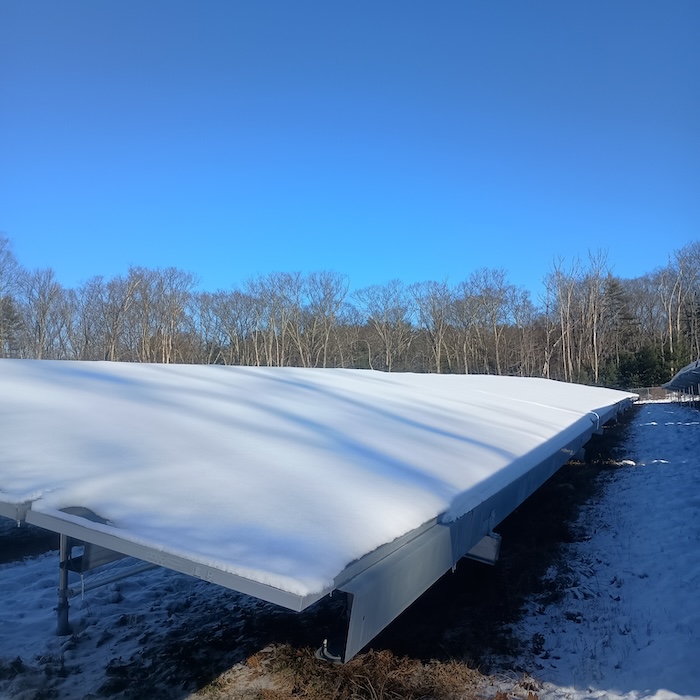
Actively clearing snow from modules eliminates soiling and overloading of racking and trackers and reduces the likelihood of moisture ingress into the module, especially on thin film products that rely on encapsulant which degrades over time. Water ingress causes shorter operational life of the module as well as electrical shorts of cells. Water ingress along with below freezing temperatures can lead to catastrophic mechanical failure of the module.
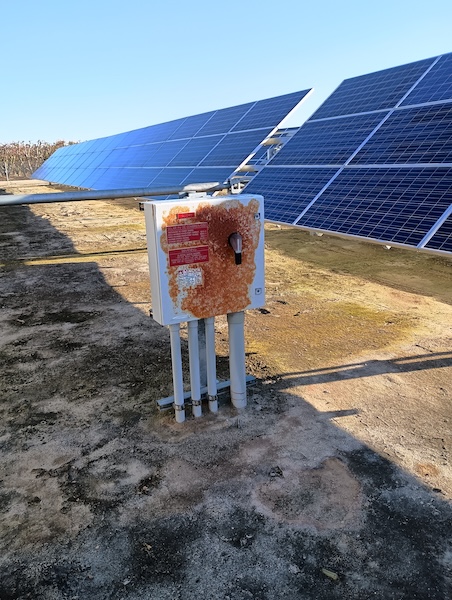
Heavy precipitation can also cause water ingress in electrical enclosures leading to electrical failure and corrosion. Combiner boxes, load break disconnects, recombiners, junction boxes, switchgears, and inverter enclosures must be inspected regularly to ensure that weather sealing remains effective.
Precipitation always finds the low spots on a PV project, typically creating large puddles and mud accumulation making travel over interior roads difficult, but also causing slow erosion within an array. Water travelling close to piles can erode them to the point of weakened structural integrity causing pile twist, pile settling, and pile leaning, all of which put unknown stress on the modules and trackers. If left to progress, this near pile erosion may cause strings to collapse. Severe wind may accelerate this.
Extreme temperatures
High ambient temperatures may derate operations of inverters. Early utility scale solar projects in high temperature regions included full enclosures to house central inverters and control cabinets. These enclosures included external filtering and separate HVAC keeping internal temperatures below a defined maximum.
Minimizing capital costs to provide the lowest dollar per watt of construction means including this type of enclosure is not economical despite the operational benefits. Inverter OEMs now rely on convective cooling with multiple fans as well as employing multi-level IGBT architecture. Some inverter OEMs are working on solutions to remove heat from systems by other methods, which will mitigate some of these issues.
Cold ambient temperatures can also cause operational issues, including increased string open circuit voltages, which may lead to inverter failure if the maximum allowable input voltage is exceeded. Extremely low temperatures, around 15⁰F (-10⁰C), also reduce inverter efficiency. Cold starts of electrical equipment can be difficult or impossible if the ambient temperature is below the operating range of the equipment, though operating from the auxiliary circuit enables preheating in cold temperatures if needed.
Issues driven by extreme weather and temperature can be mitigated or eliminated, with a combination of proper planning, siting, equipment specification and selection, installation, operation, and maintenance. New designs from OEMs to mitigate temperature-induced failure and increase the operating temperature range may also be available in the not-so-distant future.
Engineering for resilience
Extreme environmental conditions are no longer rare anomalies - they’re the new normal for solar projects across North America. From dusty deserts to frozen plains, the combined challenges of dust, moisture, and temperature demand more than basic compliance.
Long-term reliability depends on proactive design, resilient engineering, and disciplined maintenance that anticipate and adapt to real-world stresses. Developers and operators who plan for these conditions – stress-testing systems early, specifying robust equipment, and integrating continuous monitoring - will be best positioned to deliver cost-effective, durable solar assets that perform consistently throughout their lifetimes.
Kim Clark is Senior Project Engineer at Natural Power Consultants LLC, an independent consultancy and service provider that supports a global client base in the effective delivery of renewable projects, including onshore wind, solar, renewable heat, energy storage and offshore technologies. Kim joined Natural Power in 2022 and has worked in the renewable energy industry since 2011. With more than two decades of engineering experience, he specializes in technical due diligence for solar, wind, and energy storage projects. His background includes project development, independent engineering, O&M cost modeling, NERC compliance analysis, and field operations management. Kim holds a Bachelor of Science in Mechanical Engineering from the University of Massachusetts.
Natural Power | www.naturalpower.com
Author: Kim Clark
Volume: 2025 November/December