




Persistent Monitoring: How tethered UAVs enhance offshore wind


The operational reality of offshore clean energy is defined by a costly paradox. The same windswept, remote, and hydrodynamically active environments chosen for their high energy potential are also the most hostile for the assets that maintain them. For project developers and EPC firms, the Operational Expenditure (OpEx) of offshore wind farms and subsea cable networks is dominated by logistics. A single Platform Supply Vessel (PSV) can command day rates exceeding $39,000, while specialized Wind Turbine Installation Vessels (WTIVs) can surge past $220,000 per day.
Currently, aerial monitoring remains a sprint activity. A pilot launches a battery-powered multirotor from a rolling deck, fights 25-knot gusts to inspect a turbine blade or monitor a cable lay, and returns 20 minutes later to swap batteries. This model leaves 95 percent of the operational window unmonitored.
To bridge the gap between intermittent scouting and continuous asset assurance, the industry is adopting a new class of aerial infrastructure: Tethered Unmanned Aerial Vehicles (TeUAVs). By leveraging the physics of tension and hardline data transmission, these systems are eliminating the battery bottleneck and redefining maritime situational awareness.
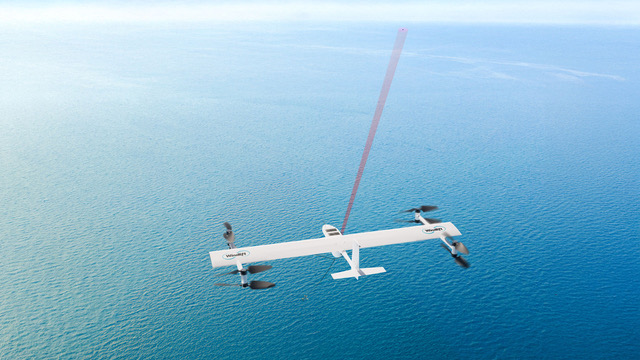
Engineering persistent flight
Unlike free-flying drones, TeUAVs remain physically connected to a vessel or offshore substation through a tether that contains high-voltage copper conductors and single-mode fiber optics. This umbilical provides two critical advantages.
First, by inverting high-voltage AC or DC from the ship to the aircraft and stepping it down to 400 volts or 800 volts to reduce current and cable mass, the drone bypasses the limits of lithium-polymer batteries. This allows for flight times measuring in days, not minutes.
Second, on a vessel the radar has a horizon limit, and fixed cameras suffer from salt spray and occlusion. A tethered drone loitering at 100 meters creates a variable-height sensor tower. This extends visual and thermal horizons by miles without the structural windage of a physical mast.
Operational challenges and engineering responses
- Navigating the dynamic interface: For the naval architect or marine engineer, the primary concern with tethered operations is the Dynamic Interface (DI), which is the interaction between a flying object and a heaving deck. Modern maritime TUAV systems have moved beyond passive spools. They utilize smart tension control algorithms that function similarly to the Active Heave Compensation (AHC) found on subsea cranes. The winch uses high-speed torque sensors to detect the vessel’s vertical acceleration (z-axis motion). As the ship rises on a swell, the winch pays out cable. As it falls, it retracts. This mechanical feedback loop ensures the drone remains effectively "bolted" to the ship's reference frame, maintaining a stable hover in sea states that would ground standard rotary-wing aircraft.
- Next-gen wind resilience: Historically, tethered multirotors faced a "hard ceiling" at wind speeds of roughly 25 mph (11 m/s), compelling operators to recover assets during critical times of high use or high stress. There isn’t a current solution to this problem within the TeUAS industry, but many companies are working on a host of solutions to it, expecting deployable solutions within 1-2 years.
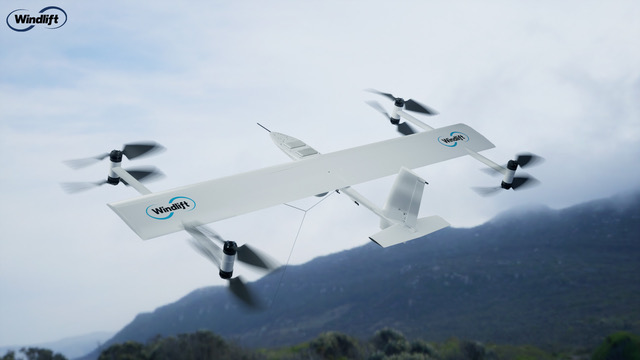
Applications across offshore operations
- Subsea cable installation and protection: The subsea cable sector, particularly for inter-array and export cables, faces unique challenges in the "Surf Zone" and during shallow-water landings. These areas are often inaccessible to ROVs (Remotely Operated Vehicles) due to turbidity and currents that make underwater visibility near-zero. During S-lay or J-lay operations, the Touchdown Point is a critical control parameter. While sonar monitors deep water, tethered UAVs provide persistent "over-the-side" visualization of the cable catenary entering the water.
This optical data feed helps the Lay Cycle Coordinator prevent bend-radius violations in real-time, avoiding costly damage to the cable's internal fiber optics. Autonomous Underwater Vehicles (AUVs) are increasingly used for scour monitoring, but they struggle to transmit data through water. A tethered UAV acting as a communications gateway can receive acoustic signals from a submerged AUV and relay them via the fiber-optic tether to the mothership. This allows the vessel to stay further away from the delicate operations zone while maintaining high-bandwidth comms.
- Wind farm security: As offshore wind farms expand, they become national infrastructure subject to increasing security mandates. A tethered UAV deployed from an Offshore Substation can provide persistent, 360-degree optical, radar, and thermal coverage. Unlike a patrol vessel, operating at 120 meters, it can identify unauthorized vessels, anchor drag risks, or unauthorized boarding attempts from miles away using AI-driven optical tracking.
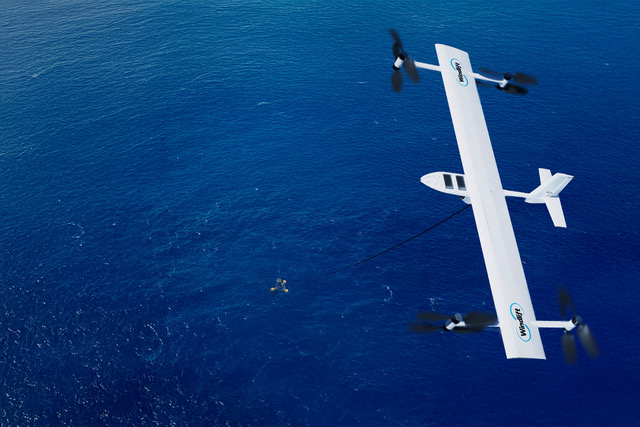
The path to autonomy
The transition is clear: we are moving from "unmanned" to "unattended." The next generation of maritime TUAVs will be fully containerized "drone-in-a-box" solutions integrated into the vessel’s power management system (PMS) or the turbine’s SCADA network.
For the North American clean energy sector, adopting these systems is not just about buying a new gadget. It is about rethinking the architecture of observation. By tethering our sensors, we untether our operations from the limitations of batteries and daylight, ensuring that even in the harshest marine environments, the lights stay on.
 Rob Creighton founded Windlift in 2006 while studying at the University of Wisconsin-Madison, where he earned a B.S. in Genetics and an MBA in Strategic Management. With nearly two decades of leadership at the intersection of defense, energy, and autonomy, he is recognized as a pioneer in airborne wind energy. Rob's vision is to build aerial, tethered systems that deliver where traditional infrastructure fails. Under his leadership, Windlift has secured more than $24 million in U.S. government R&D funding.
Windlift | windlift.com
Author: Rob Creighton
Volume: 2026 January/February