




Moving Giants: The hidden logistics behind wind energy transportation


Wind energy turbines have become one of the most recognizable symbols of the global energy transition. Their unmistakable profile can be spotted across the farmlands, coastlines, and ridgelines of North America, a striking reminder of the leaps and bounds green energy has made in the past decades.
Despite this visibility, few outside the industry are likely to have considered what it takes to get these massive components from their origin to their final installation sites.
Transporting wind energy components is a challenge unlike almost any other in freight transportation. Far from simple oversized loads, these are highly engineered structures that demand purpose-built equipment, extensive planning, and precise coordination among dozens of specialized professionals.
As wind projects grow in scale, the logistics required to support them has necessarily evolved into a specialized discipline of its own, enabling the projects that are reshaping our nation's landscape — and the landscape of our global energy infrastructure itself.
Innovation paced to scale
The rapid growth and development of wind energy technology have required the transportation industry to innovate at a similar, if not faster, pace.
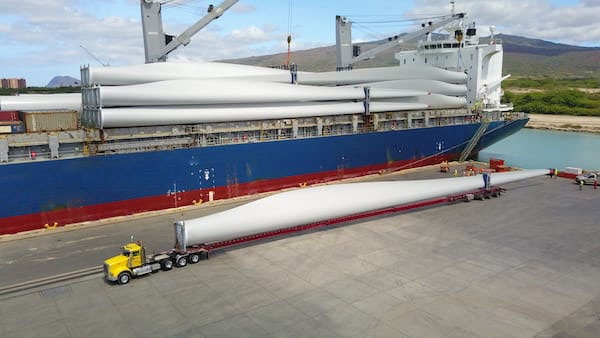
Trailer configurations were engineered specifically to support longer, heavier tower sections. Blade trailers evolved to include steerable and articulated systems capable of navigating tight turns, uneven terrain, and complex roadway geometry without damaging delicate components. In some cases, entirely new transport solutions must be custom designed just to make movement feasible.
While this specialized equipment is essential, people remain the backbone of wind logistics. A single wind project can involve dozens of logistics professionals, including project managers, route engineers, permitting specialists, technical services teams, site supervisors, and highly trained drivers and pilot cars.
Rising to the larger-than-life challenges presented by these projects requires these experts to work in concert for months, if not years, in advance to line up every detail with pinpoint accuracy.
Indeed, one of the least visible, but most critical, aspects of wind component transport is time. Unlike typical freight, wind components are often tied to immovable installation schedules, adherence to which is non-negotiable. Cranes, specialized construction crews, and commissioning teams wait in the wings while transportation is coordinated, and delays can cascade into enormous costs.
Transportation schedules are therefore reverse engineered from fixed installation dates, with little margin for error. For complex projects, planning can begin anywhere from six months to more than a year before the first truck ever departs.
A coordinated effort
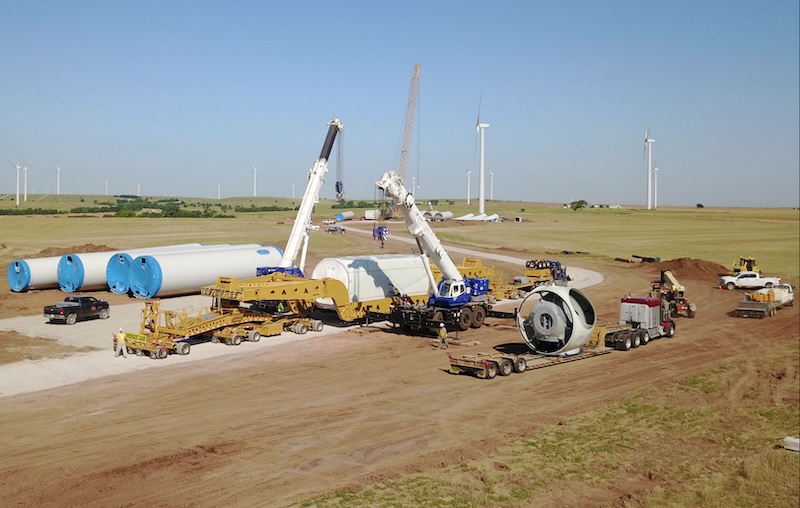
The planning phase of a wind energy move involves much more than booking trucks and drivers. Route planning, for example, is less about finding a path and more about shaping one. Routes must be engineered in detail to account for turning radii, grades, bridge capacities, overhead obstructions, and road conditions.
In many cases, roads must be modified or temporarily reconfigured to allow safe passage. Signage may be removed and replaced, intersections widened, or shoulders reinforced. In extreme cases, entirely new access roads are constructed to reach remote project sites.
Coordination with state and local authorities is constant. Public safety, infrastructure protection, and traffic flow all factor into decisions about when and how moves can occur. Logistics project managers must communicate early and often with states to work around road work and infrastructure improvement projects that might otherwise delay transportation by days, weeks, or even months.
Meanwhile, permits are secured across multiple jurisdictions, often simultaneously, while contingency plans are developed for unpredictable variables like weather or equipment breakdowns. Because of the size and visibility of wind components, these transports often draw public attention, adding another layer of complexity to already sensitive operations.
For months, logistics professionals work to line up every detail of a move, down to each individual turn the driver will make along their route. But the job isn't complete once that truck is loaded. With this massive freight finally in motion, a new phase of critical coordination and communication begins, and the pressure is on.
Driving success
At peak activity, a single wind project may have dozens of drivers operating simultaneously, which requires complete adherence not only to scrupulous safety standards, but to carefully planned strategies for staging, parking, fuel access, and weight and routing restrictions.
As you may imagine, the job of a wind component truck driver is not easily won. Drivers must log years of on-the-road experience in heavy haul trucking — with an impeccable safety record, to boot — before they are even eligible for wind-specific training. Operating these loads demands precision, patience, and constant situational awareness.
Blade and tower section transport in particular often requires a two-person team, with a driver and a steerman working in close coordination to control trailer articulation through turns and elevation changes.
Communication is critical, not only between drivers but across the entire project team. Site supervisors are on the ground to manage coordination day-of, which allows drivers to focus exclusively on the project's priority: safe, damage-free transportation and delivery. This support structure helps reduce stress in an environment where even minor mistakes can have significant consequences.
Every stop, transfer, and handoff must be planned to prevent cargo damage, avoid delays, and maintain safety; each participant plays an essential role in maintaining the operational rigor necessary to achieve these goals.
Logistics expertise
What ultimately distinguishes successful wind transportation is expertise. Wind projects are interconnected systems: a delay in permitting, a miscalculated route, or a mechanical issue can ripple through the entire project to costly effect.
Experienced logistics teams understand that most project risk is addressed long before any freight is tendered. Meticulous, proactive planning, coordination and communication across all parties, and an unwavering commitment to safety account for the majority of project success.
By the time components are on the road, the outcome has largely been determined by the quality of planning behind the scenes and the industry-specific experience of the professionals therein.
As wind's footprint expands, technology advances, and the logistical effort and expertise required grows more complex, the importance of partnering with a transportation provider with the experience and resources to execute these projects successfully will only increase accordingly.
The next time a wind turbine appears on the horizon, it’s worth remembering that it did not appear there overnight, nor without the work of hundreds of unseen hands. Behind every blade turning is a carefully orchestrated transportation effort, silently enabling the world's clean energy transition one move at a time.
 Gene Lemke is SVP, GM Projects and Heavy Haul at Anderson Trucking Service, Inc. (ATS). Backed by 70 years of transportation experience, ATS delivers reliable freight shipping solutions across North America and around the world.
Anderson Trucking Service, Inc. | www.atsinc.com
Author: Gene Lemke
Volume: 2026 March/April