




Making the Impassible Possible: Smarter temporary crossing solutions for wind projects


As wind development pushes into more remote and environmentally sensitive terrain, site access is no longer a secondary concern. It is a primary project risk. Unstable soils, seasonal flooding, protected wetlands, and water crossings can derail permitting, trigger regulatory violations, and expose developers to costly remediation. Temporary bridging, when done properly, is a genuine project enabler. Done poorly, it becomes a liability that compounds quickly. And with regulators, utilities, and EPCs increasingly requiring engineered solutions with documented specifications, the bar for “good enough” is rising.
Start with risk management
Before selecting any crossing solution, two questions matter most: what is the potential impact, and what is the severity if something goes wrong? A flood event that pushes an undersized timber crossing down a right-of-way creates cascading problems (blocked water flow, debris violations, permit consequences) that quickly outweigh the cost of a more robust solution. That said, risk management doesn’t mean defaulting to the most complex option; non-engineered approaches are adequate in many situations. The goal is honest assessment against actual site conditions — don’t assume that more engineering always equals more value.
Choose wisely
Selecting the right crossing requires evaluating conditions across three categories: operational, environmental, and logistical.
Operational factors include equipment weight, type, and traffic frequency. Wheeled and tracked equipment behave differently on a bridge; vehicle length, axle spread, and counterweights all affect load distribution. Ratings must reflect peak weights across the full equipment range, not just the primary piece.
Environmental factors govern what solutions are even permissible. Water flow restrictions, soil erosion requirements, floodplain designations, and protected species can all eliminate options that would otherwise be viable. Importantly, these factors also determine permitting timelines — and permits drive schedules. Teams that don’t understand the environmental requirements at each crossing location may find themselves waiting on approvals long after mobilization was planned to begin.
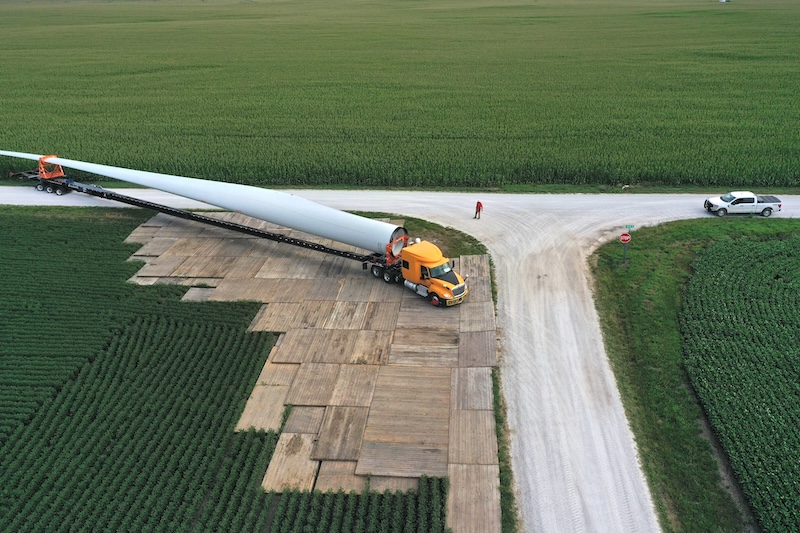
Logistical constraints are frequently underweighted. Road width limits on rural access routes affect what can be transported to the site. Working area on each bank determines whether installation requires access from both sides. Overhead obstructions, bank stability, soil makeup, and seasonal weather variability (i.e., a dry channel in summer that runs fast in fall and floods in spring) should all be assessed before a solution is chosen, not after it arrives on site.
Matching solution to site
Crossing solutions span a wide range, from simplest to most complex, and each carries distinct trade-offs in cost, speed, load capacity, and environmental impact.
Solid fill and matting suits wetland crossings with adequate soil bearing, but it carries high material demand and environmental impact, especially when the site must be fully restored. Culverts work for simple ditch crossings, but they require waterway capacity, their own permits, and can be disqualified in regulated flow situations. Timber mat crossings are common and flexible, but are not engineered products; load calculations rely heavily on field judgment, and cleanup can be difficult when permit conditions prohibit debris in the waterway, which is increasingly the standard.
Engineered mat products — including cross-laminated timber mats with documented load specifications — can serve as structural components within a larger assembly. Placed perpendicular to timber stringers, they distribute weight across a wider area, reduce shifting, and improve long-term stability. This hybrid approach offers a meaningful step up from purely field-improvised solutions, without requiring a fully prefabricated system.
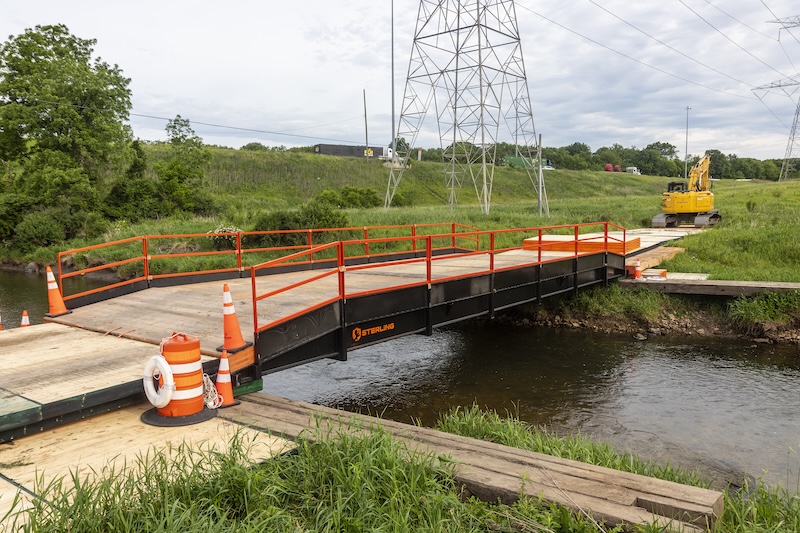
Modular engineered bridge systems offer the highest performance for demanding crossings. Fully engineered and assembled in the field from manageable components, they are built for rapid deployment and clean removal. A key advantage is single-bank installation, which resolves access problems where terrain or property boundaries prevent reaching the opposite side. Because they are modular, a single unit can often be relocated to multiple crossing locations on the same project, reducing overall cost.
For the most demanding spans, floating systems and industry adaptations such as repurposed rail car frames extend the range of what’s possible, though they require specialized equipment and carry higher risk.
Field conditions that change the calculus
Consider a project with a 25-foot water crossing where an existing private bridge had to be protected rather than used. It was one of five crossings on the project, permits prohibited any debris in the waterway, and access was limited to one bank due to narrow rural roads, with the opposite bank presenting uneven terrain. The solution needed to be engineered, single-bank installable, narrow-road legal, and reusable across locations to control cost. A modular system was installed in a single day and then relocated to serve all four remaining crossings.
At the other end of the complexity spectrum was an 80-foot crossing at a high-security facility that required transporting a large control house over water with strict constraints on elevation change and deflection. The solution combined barge systems for buoyancy and height control, engineered bank anchors, and timber matting to complete the span. This hybrid was assembled specifically for conditions no single product could address.
Both cases make the same point: the right solution emerges from thorough site assessment. Getting eyes on a site before finalizing a crossing plan isn’t optional — there are too many variables that a width measurement and a soil type won’t reveal.
Plan early, plan thoroughly
The most consistent source of crossing-related delays is treating bridge selection as a late-stage logistics call. Permitting, equipment analysis, site evaluation, and procurement all take time that isn’t available once mobilization is underway. Building crossing planning into early project development, accounting for seasonal variability, and aligning solution selection with environmental permit requirements keeps construction on schedule.
The upfront cost of a more robust solution is almost always smaller than the cost of a crossing failure, a lost construction window, or a regulatory enforcement action. In an industry where outage schedules are set months in advance and timelines are tied to interconnection queues, access reliability is a project-critical input. It deserves to be treated as such from day one.
Brent Sedlacek is Director of Sustainability at Sterling Solutions, which provides site access made from sustainably-sourced, domestic wood, and used by major utilities across the United States. For 75 years, Sterling has innovated and delivered sustainable solutions that meet customer needs, create jobs and economic opportunity, and reduce the risk and environmental impact of construction projects.
Sterling Solutions | sterlingsolutions.com
Author: Brent Sedlacek
Volume: 2026 May/June