




Guiding the Spark: A new coating Approach for Lightning Protection of Wind Turbine Blades


Lightning has long been the top cause of blade failure in the wind industry. Each year, thousands of turbine blades are taken offline due to damage ranging from skin punctures to catastrophic delamination. As turbines grow taller and more exposed, this problem is only intensifying. But a new kind of surface coating is offering a different path forward — one that doesn’t just endure lightning, but actively influences how and where it strikes.
The real race in the sky
To understand the new approach, it helps to revisit how lightning works. When a thundercloud builds up charge, it initiates stepped leaders that crawl downward toward the ground. At the same time, upward leaders begin to emerge from elevated structures — turbines, buildings, even trees — vying to connect first.
The point where a downward and upward leader connect becomes the path of the lightning bolt. Every modern turbine blade includes a lightning protection system (LPS) designed to produce upward leaders, usually by placing conductive receptors near the tip and connecting them to ground with internal down conductors. Ideally, the upward leader from the receptor is the strongest, connects to the charged cloud first, and safely channels the energy to ground and away from the composite blade structure.
In practice, though, things don’t always go according to plan. Competing leaders sometimes form from the down conductor inside the blade and reach through the laminate. These internal paths can “win the race” to the cloud, resulting in lightning punctures, burned laminate, and damaged internal components.
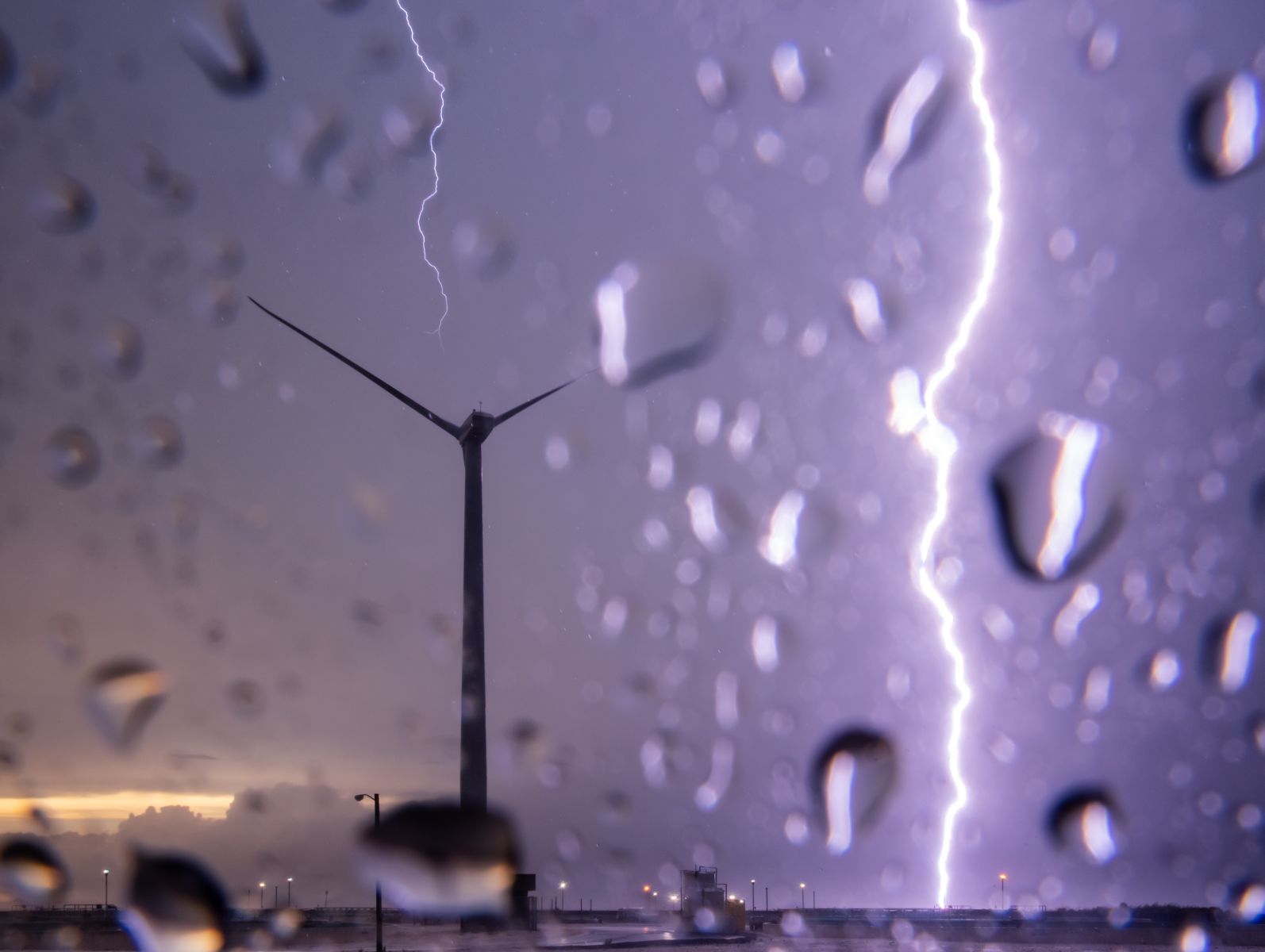
Figure 1: Lightning event captured during Arctura’s pilot study
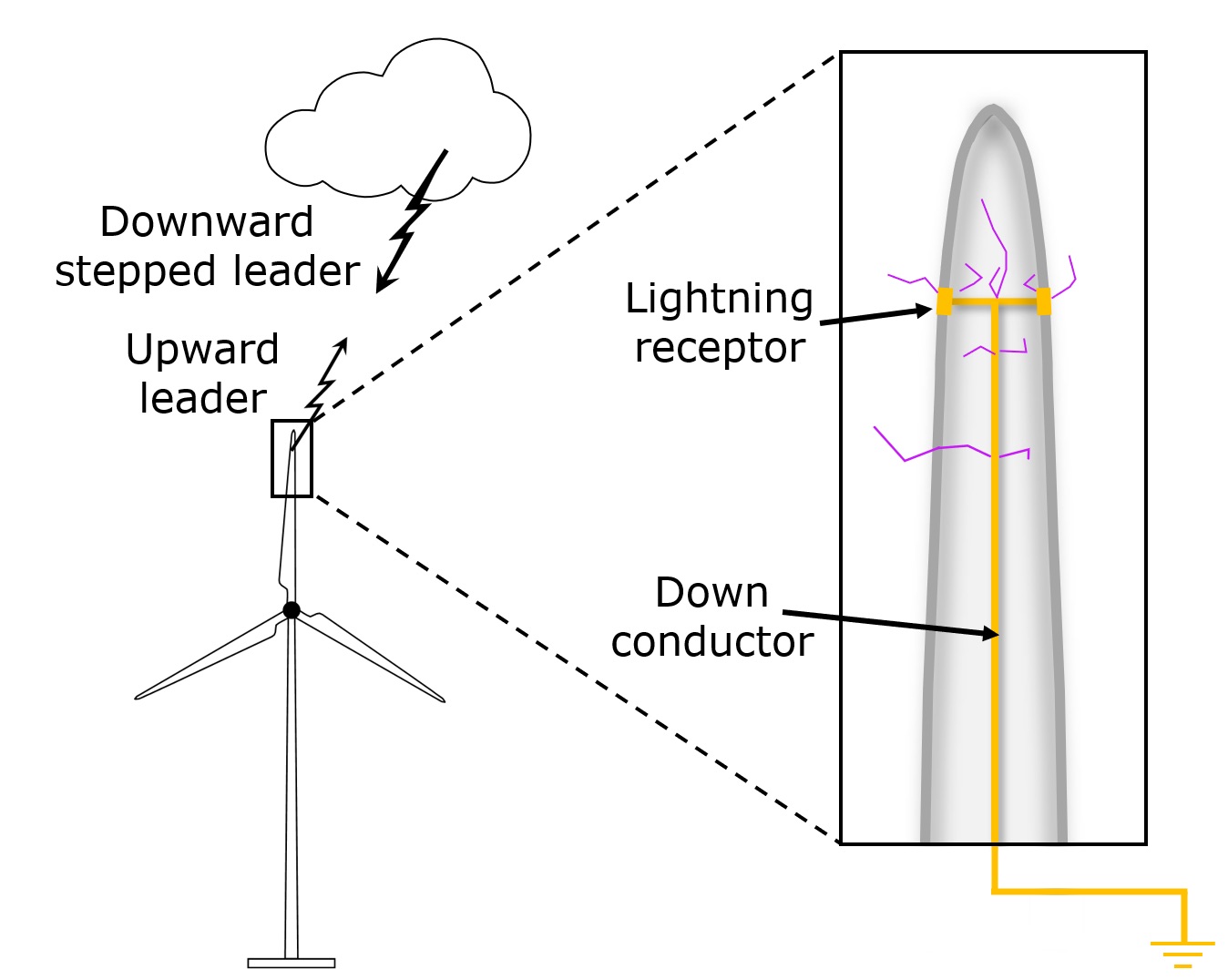
Figure 2: Diagram of a wind turbine blade equipped with a standard LPS, showing the pathway of a lightning strike
A new idea: Shape the field before the strike
Instead of redesigning the entire LPS, recent work has focused on modifying the electric field just outside the blade — right where it matters most in the milliseconds before a strike.
A new topcoat formulation incorporates minute conductive particles of a particular size, shape, concentration, and material into a standard polyurethane matrix. These particles don’t carry current like a conductive film, but instead promote early ionization of the air just above the surface. In effect, they create a pre-ionized “launchpad” for the receptor’s upward leader.
By encouraging stronger and earlier leader formation at the intended receptor, the coating increases the chances that the strike will attach safely — before unwanted leaders form elsewhere.
Segmented diverters: A flawed workaround
Some turbine operators have turned to segmented diverters to improve blade tip protection. These are typically strips of adhesive-backed metal foil “dots” arranged in a pattern near the blade tip, designed to help guide strikes to the receptor zone.
Segmented diverters work similarly by encouraging surface flashover — allowing the arc to travel across the blade rather than through it, but they come with significant drawbacks. Because they are a glued-on raised strip, they are susceptible to erosion, peeling, and water ingress. They also introduce step-changes in surface shape, which can degrade aerodynamics and reduce energy capture.
Most critically, segmented diverters are often sacrificial. In many cases, they fail after a single strike and must be inspected and replaced regularly to maintain protection — adding recurring costs and maintenance burden for operators.
The new coating approach offers a fundamentally different solution. Applied flush to the blade surface, it forms a durable bond and has been validated to withstand worst-case scenario lightning currents. Because the current travels through ionized air just above the surface — not through the coating itself — it experiences no degradation even after repeated strikes. As a result, a single application can provide protection for the remaining life of the blade.
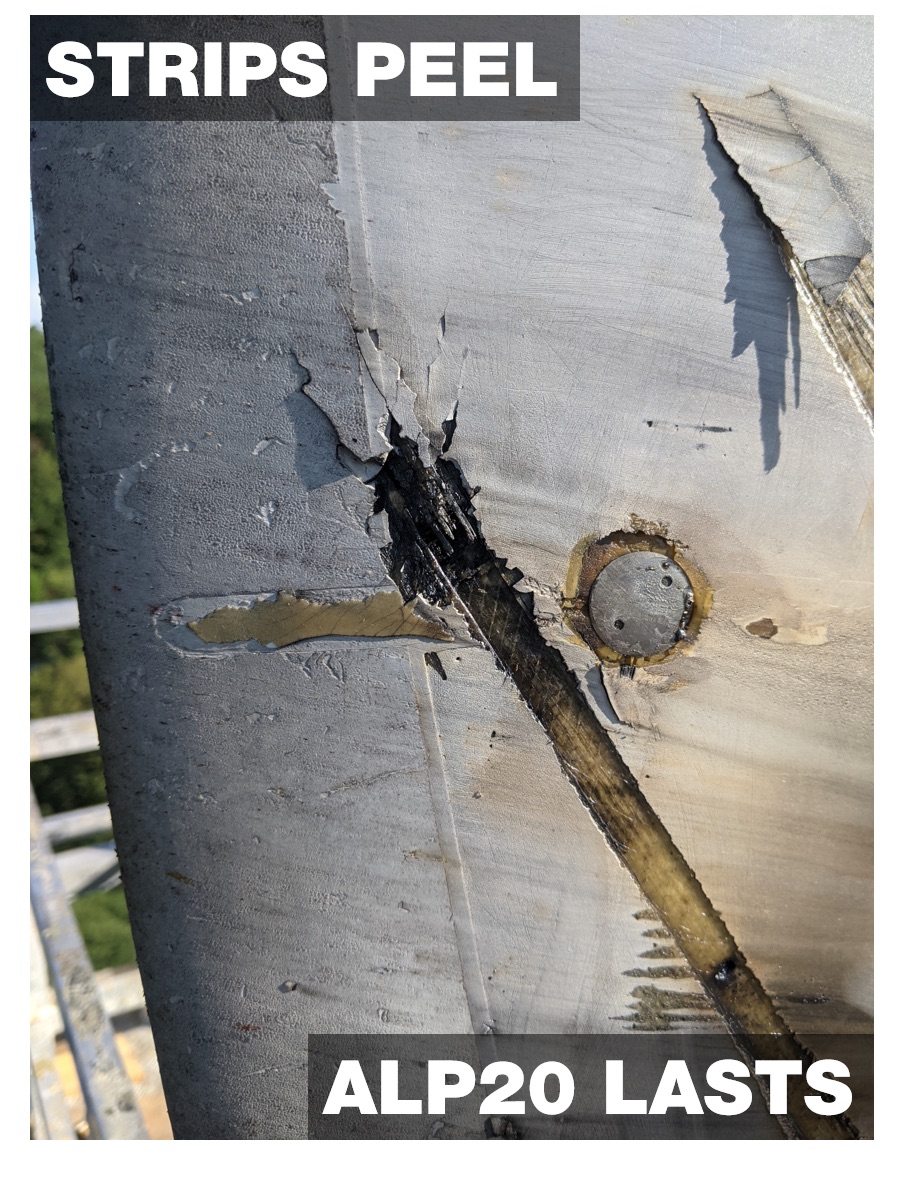
Figure 3: Failed segmented diverter
Field testing and real-world results
Laboratory validation is necessary, but field validation is indispensable. Since 2021, pilot installations of the coating have been running on turbines at two U.S. wind farms, with ongoing monitoring.
Drone inspections after multiple seasons of operation show no degradation, flaking, or adhesion issues. No lightning-related blade damage has been reported to date on the treated units. Additional deployments are underway to expand the sample set and evaluate longer-term performance.
Meanwhile, full-scale validation using retired blade tips has also been completed. In over 150 simulated lightning events across a range of blade angles and orientations, blades treated with the coating showed 73 percent fewer punctures than untreated ones. At blade orientations where most real-world strikes occur, the coating eliminated blade damage entirely.
A new standard for blade resilience
The coating is applied like any basic topcoat: sand the area, clean, apply two layers with a roller (allowing for a roughly 40 minutes flash off time between coats), and allow to cure. It integrates seamlessly with common maintenance routines and requires no special equipment or training. And because it doesn’t degrade with each strike, it only needs to be applied once per blade.
As wind turbines push toward greater heights and higher capacity factors, protecting uptime becomes ever more critical. This new coating doesn’t replace existing systems — it enhances them. By improving the odds that lightning hits where it should, it protects blades, reduces repair costs, and avoids unnecessary downtime.
Just as the original lightning rod transformed building protection nearly 300 years ago, surface treatments that shape electric fields are opening the door to a new era in turbine protection — one where we work with lightning, not against it.
Neal Fine is the CEO and Founder of renewable energy startup Arctura, which focuses on advanced materials for wind energy and sustainability. He holds a Ph.D. from MIT in Marine Engineering and has over 30 years of experience in fluid mechanics, plasma physics, high-voltage systems, and technology innovation. Neal leads the team behind a novel lightning protection coating for wind turbine blades, developed through a U.S. Department of Energy-supported program.Neal also acts as a consultant to Mankiewicz.
Arctura | www.arcturawind.com
Author: Neal Fine, PhD
Volume: 2026 January/February