




Charybdis and Sturgeon: A common purpose through diverging design philosophies


The U.S. offshore wind sector has been gaining ground for over a decade. But this rapid scale-up also brought a direct collision with a longstanding maritime law that would define how these wind farms could be built: the Jones Act.
The Jones Act, a 1920 maritime law, sits at the center of U.S. offshore wind construction. It requires that any vessel transporting “merchandise” between two U.S. points be U.S.-built, owned, flagged, and crewed. Since offshore turbines and substations on the Outer Continental Shelf are legally treated as U.S. points, moving components from a domestic port to a wind site falls under these rules.
In Europe, installation vessels freely shuttle between the nearest port and the site. That model doesn’t work in the U.S. — the Jones Act blocks it.
The rise of feedering
One workaround is the feeder vessel method, which keeps the heavy-lift WTIV stationed offshore while Jones Act-compliant feeder barges shuttle turbine components from port. The foreign WTIV never moves goods between domestic points: it stays at the wind farm and receives components at sea from U.S.-flagged tugs and barges.
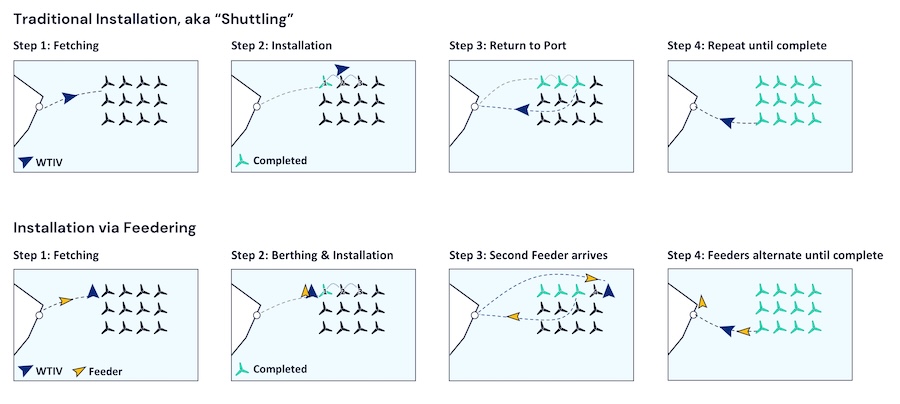
Diagram illustrating shuttling and feedering operations in turbine installation
Already tested in Europe, feedering is ideal for the U.S. because it allows developers to tap into available, high-capacity foreign WTIVs without waiting on new U.S. builds. It also avoids the constraint of limited deepwater ports — if a WTIV can’t dock, feeder barges can deliver components offshore.
But the method comes with drawbacks. Offshore transfers are weather-dependent and require tight coordination between multiple vessels. Data shows turbine installs via feedering generally take longer per unit due to the logistical hurdles.
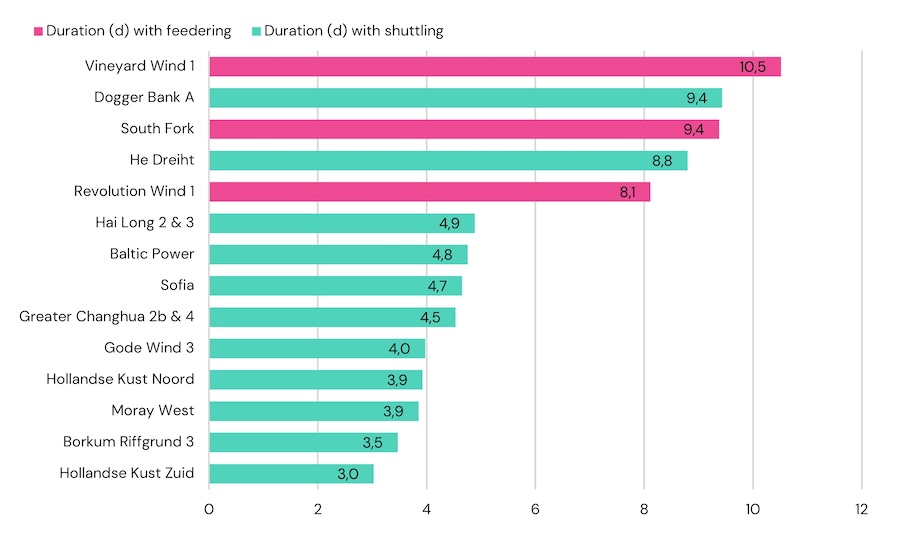
Bar chart: average time per completed turbine installation of recent offshore wind farms with 11-15 MW turbines
The Canadian workaround
Rather than risk disobeying the Jones Act, the Coastal Virginia Offshore Wind (CVOW) demo project had the Luxembourg-flagged and owned WTIV Vole au vent pick up two turbines at Halifax, Nova Scotia, and installed them off Virginia.
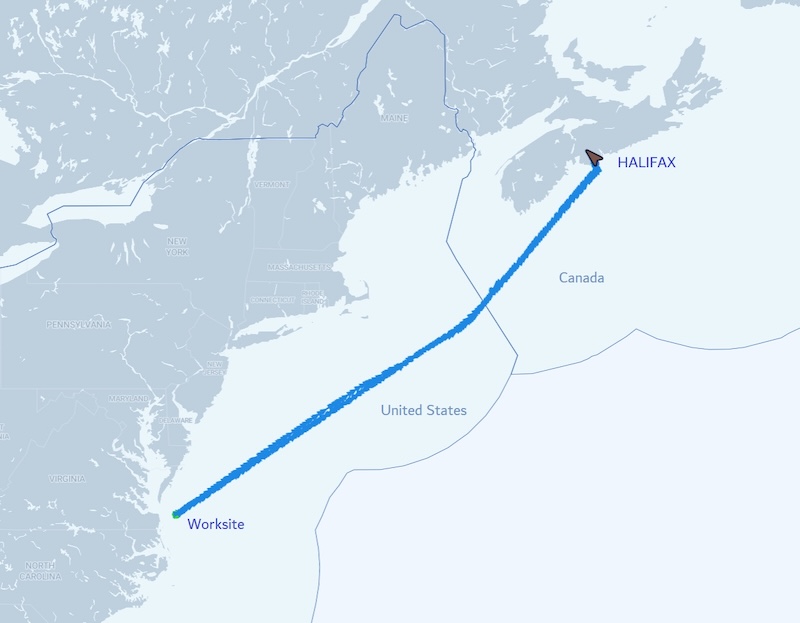
Vole au Vent’s route shuttling from Halifax to Virginia, 2020 (credit: Spinergie)
However, the trade-offs are significant. Using a distant foreign port means long transits for each turbine or foundation. In the CVOW demo, the 850-mile round-trip per load added nearly six days to each cycle. Developers have since turned to the closest foreign ports, with Eastern Canada emerging as a hub. Still, it's an inefficient workaround born of necessity.
Building Jones Act WTIVs (almost)
Due to the limitations of feedering and the inefficiencies of relying on Canadian ports, the most direct solution is to build Jones Act-compliant installation vessels. From an industry standpoint, this makes sense: long-term growth demands a strong domestic supply chain.
By the mid-2020s, only one such vessel had been built: the Charybdis. Others were planned but abandoned. Building these ships is a major investment — typically over $400 million — and takes years to complete. For vessel owners, the risk is high: betting on long-term U.S. demand and contracting U.S. shipyards with no WTIV shipbuilding experience.
But what if a company could tap into the cost and experience advantages of APAC yards while still complying with the Jones Act? Legally, that’s a dead end. Operationally, however, there’s another path — return to feedering, but reimagined.
Instead of stabilizing a barge alongside a WTIV to lift components, why not integrate the barge into the WTIV itself? A jack-up with a hull designed to receive and lock in a feeder barge could eliminate much of the offshore handling friction.
This idea gave rise to a new generation of hybrid “feeder-ready” concepts, such as Sturgeon, a vessel built specifically around renewed feeder efficiency.
The Sturgeon is a feeder-based WTIV specifically tailored to U.S. Jones Act requirements. The design included a patented system where a Jones Act-compliant barge — towed by a matching U.S.-flagged tug — would slot in the WTIV’s hull to transfer components.
By mid-2025, the ship was 99 percent complete and preparing for sea trials before heading to U.S. waters.
But the U.S. offshore wind market soon faltered. Inflation and supply chain pressures pushed project costs up, and several major developments were delayed, renegotiated, or scrapped. The Sturgeon suddenly had no clear path to long-term employment.
The first U.S.-built WTIV
Announced in 2020, the Charybdis marked an early bet that investing in a Jones Act-compliant WTIV would pay off long term, securing dedicated installation capacity for the Virginia wind farm and other projects.
Being first, its journey came with hurdles. Still, in 2026, Charybdis is installing its first turbines as the only fully Jones Act-compliant WTIV in existence. If it delivers on its promise, it could install turbines far faster than feeder setups and set a new benchmark for installation efficiency in U.S. waters.
How Jones Act installation vessels compare
Charybdis and Sturgeon are both around 145 meters long. Sturgeon is significantly wider at 83.2 meters versus Charybdis’ 56, due to its integrated feeder barge system, which also enhances offshore stability.
In terms of installation specs, Charybdis has the edge with a larger deck (5,400 m² vs. 4,000 m²) and a higher-capacity crane (2,200 t vs. 1,900 t). Sturgeon, however, features a longer boom, offering more reach for installing taller turbines in the 15-20 MW range.
Against a comparable European WTIV, such as Seaway Ventus, all three vessels are in the same tier, with similar deck space, 65-meter depth ratings, and turbine handling capabilities. Though tailored for U.S. use, neither Charybdis nor Sturgeon is regionally locked. Sturgeon is globally deployable, and may indeed find work abroad amid lack of U.S. demand. Charybdis, with its conventional setup, is well aligned for near-term U.S. projects and future maintenance roles.
Yvan Gelbart is Lead Analyst at Spinergie, a Certified B Corporation that develops SaaS B2B solutions applying data science to the maritime sector.
Spinergie | www.spinergie.com
Author: Yvan Gelbart
Volume: 2026 March/April