




Tracking the Tracker in GW Scale


In the early 2000s, as utility-scale solar installations began to ramp up, solar trackers became an invaluable tool in the race for greater efficiency and economic viability. Now they are a standard feature in utility-scale solar farms worldwide. Currently, the global tracker market stands at $10.79 billion, projected to reach $40 billion by 2034 [1]. In the United States, most new large-scale projects use single-axis trackers that deliver 20–35 percent higher yield compared to fixed-tilt systems. Yet, despite their widespread adoption and scale, surprisingly few large-scale studies examine tracker reliability in real-world operations.
While small-scale analyses exist, gigawatt-scale operators typically treat recurring tracker issues as site-specific rather than systemic. To remedy this glaring oversight, the EU funded the Horizon Supernova project which combines ongoing research from a score of major players in the solar industry.
Project experts with access to multi-gigawatt datasets had two key questions:
- How reliable are solar trackers in practice?
- Where do they most commonly fail?
The hope is that this work encourages other industry stakeholders to conduct similar analyses, and contribute to improved quality standards and grid stability.
Dataset and methodology
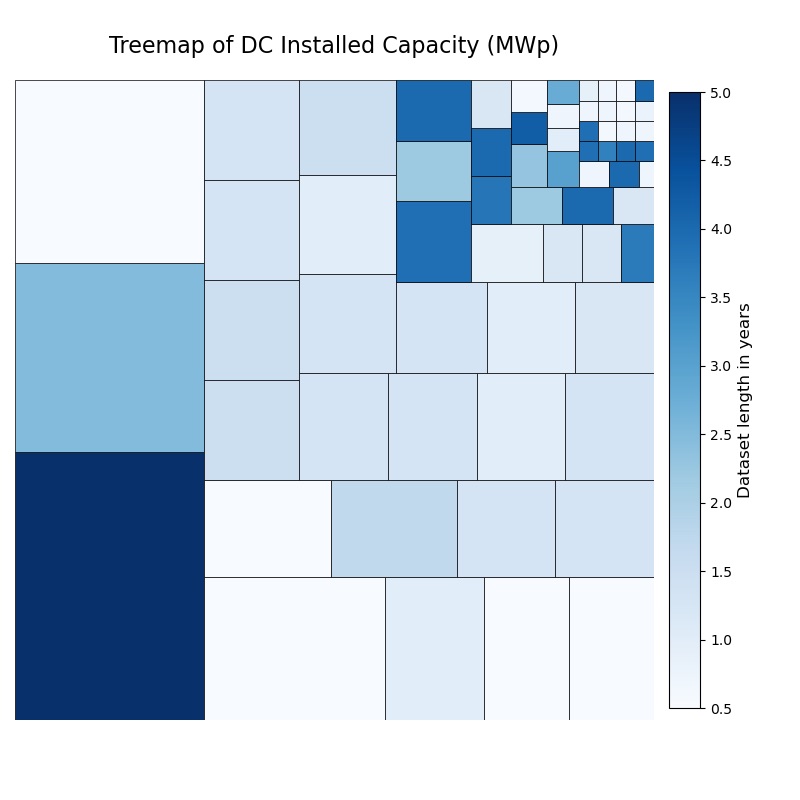
Analysis covered 64 utility-scale PV plants, representing 2.1 GWp DC capacity, with datasets spanning six months to five years. Approximately 80 percent of the sites are located in Europe, primarily in temperate and Mediterranean climates.
To isolate tracker performance from broader plant-level effects, a dedicated KPI was developed: Tracker Availability, focused strictly on mechanical and control uptime.
Actual tracker angles from SCADA systems (1- to 15-minute resolution) were benchmarked against reference angles modelled using PVLIB, based on as-built parameters such as pitch and ground coverage ratio. Trackers deviating by more than 5 degrees from the reference angle were classified as unavailable.
Only periods with plane-of-array irradiance above 0 W/m² were considered. Wind stow positions and planned maintenance events were treated as available time.
Availability was assessed under two operational windows:
- All tracking – the full daily cycle, including backtracking at dawn and dusk
- Core tracking – peak production hours only
Data quality constraints
Data quality emerged as a major limiting factor. Fifteen plants were excluded due to severe issues, including stalled signals, scaling and offset errors, and mismatches between angle data and generation profiles
Even after exclusions, the dataset comprised hundreds of thousands of tracker records sufficient to identify robust performance patterns.
Data gaps were frequent, and therefore analyzed under two assumptions:
- Conservative scenario – communication gaps treated as unavailability
- Best-case scenario – communication gaps treated as available time
Under the conservative scenario:
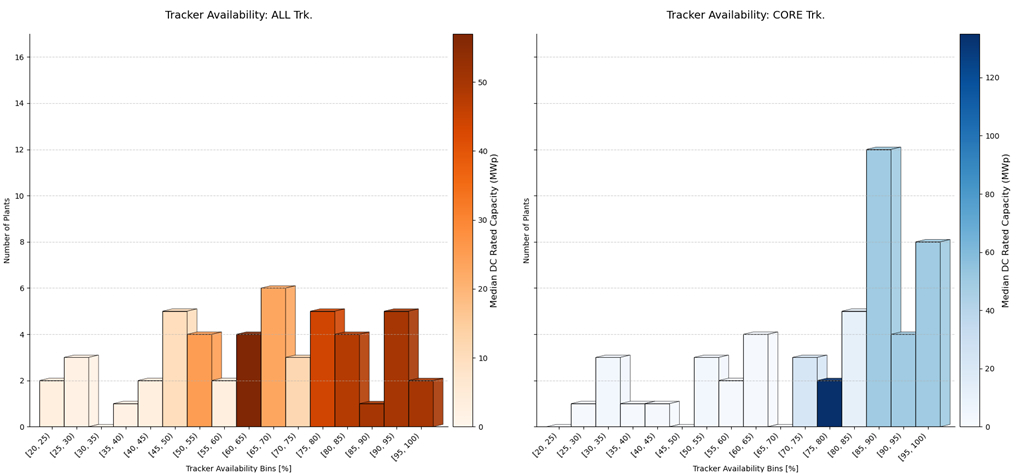
- All Tracking: 66 percent median availability (64 percent average; range 22–96 percent)
- Core Tracking: 83 percent median availability (76 percent average)
The 17 percentage-point gap highlights weaker performance during backtracking and early morning hours, when overnight faults often persist until manual intervention.
Missing data medians reached:
- 11 percent for All Tracking
- 5 percent for Core Tracking
Some plants lost up to 70 percent of tracker records.
Under the best-case assumption (gaps counted as available), median availability increased to:
- 87 percent (All Tracking)
- 89 percent (Core Tracking)
These values remain significantly below the 99 percent availability typically assumed in financial models.
Beyond communication gaps, structural data issues further reduced confidence. Scaling and offset errors distorted angle profiles, while as‑built limits sometimes conflicted with observed motion (e.g. ±65 degrees versus documented ±60 degrees). Year‑to‑year shifts in tracker alignment hinted at calibration drift or wear.
String-level power data helped validate performance on clear days, but tracker angle data proved the most reliable indicator of mechanical behaviour.
Why tracker availability matters
The low LCOE of solar PV is strongly linked to tracker deployment. Yet tracker performance is often overlooked in contracts, where performance ratio (PR) and inverter availability dominate.
In an environment of tightening margins, even small availability losses materially affect revenue.
By isolating mechanical and control faults from optimization adjustments, potential improvements include:
- Prioritizing tracker angle and log monitoring
- Automated alerts for deviations exceeding 5 degrees
- Redundant communication systems
- Machine-learning-enhanced backtracking optimization
High-density layouts can strain communication networks, while ageing plants face increasing mechanical wear. Embedding tracker availability requirements into contracts, aligned with emerging guidance from certain organizations like IEA, would reduce ambiguity and strengthen accountability.
Toward standardized tracker performance metrics
This work is among the first to systematically evaluate tracker availability across such a broad portfolio of PV plants.
By introducing a simple yet robust KPI methodology, the study aims to enable better communication between manufacturers, EPCs, and asset owners and ultimately enhance operational transparency in the solar industry.
As the sector moves toward tighter margins and higher performance expectations, understanding and quantifying tracker performance becomes a key element in reducing uncertainty, improving energy yield, and ensuring bankable assets.
Reference
[1] https://www.fortunebusinessinsights.com/industry-reports/solar-tracker-market-100448
As Head of Innovation at 3E, Gofran Chowdhury leads strategic efforts to transform renewable energy integration into a resilient, intelligent, and cyber-secure system. He focuses on shaping future energy landscapes through digital twins, AI-enhanced frameworks, and a deep commitment to sustainable, secure infrastructure development.
3E | www.3eco.com
Giuliano Luchetta Martins is a mechanical engineer at Statkraft, which develops and operates renewable energy assets, buys and sells energy, and invests 100 per cent of its growth entirely in renewables. Guiliano holds a Masters in Photovoltaic Engineering and has more than 5 years of experience in Research and Data Science activities.
Statkraft | www.statkraft.com
Author: Dr. Gofran Chowdhury and Giuliano Luchetta Martins
Volume: 2026 March/April