




National Nonprofit Releases New Report Helping Consumers Go Solar through Third-Party Leases


Solar United Neighbors announced a new report, PPAs & Solar Leases: A practical guide to understanding third-party solar ownership, designed to help consumers navigate one of the fastest-growing pathways to rooftop solar adoption. The report highlights how third-party ownership models—including Power Purchase Agreements (PPAs) and solar leases—are rapidly expanding access to clean energy nationwide. According to the report, “Power Purchase Agreements (PPAs) or solar leases account for 45% of residential solar installations.”
“These models allow you to go solar without upfront installation costs while accessing solar energy and potential savings,” the report explains.
With federal policy changes shifting incentives toward commercial ownership, third-party solar has become an increasingly important tool for homeowners. Under these arrangements, “the PPA provider owns the solar system and is responsible for maintaining, repairing, and monitoring it throughout the contract term,” while also receiving available tax incentives.
The report emphasizes that these incentives are passed through to consumers: “These incentives are typically factored into the agreement and should help reduce your monthly payment.”
Solar United Neighbors notes that third-party models can open the door for households who may not otherwise be able to install solar. As the report states, PPAs and leases provide:
- “No upfront installation cost”
- “Immediate energy bill savings”
- “No maintenance responsibilities”
- “Predictable costs and long-term energy planning”
The guide also explains how PPAs work in practice: “A solar company installs solar panels on your roof at no upfront cost to you… you agree to buy the electricity the panels produce,” often “at a rate lower than what you would typically pay your utility company.”
At the same time, the report underscores the importance of consumer education. For example, some agreements include long-term contracts, with “most PPA contracts run between 15 and 25 years.”
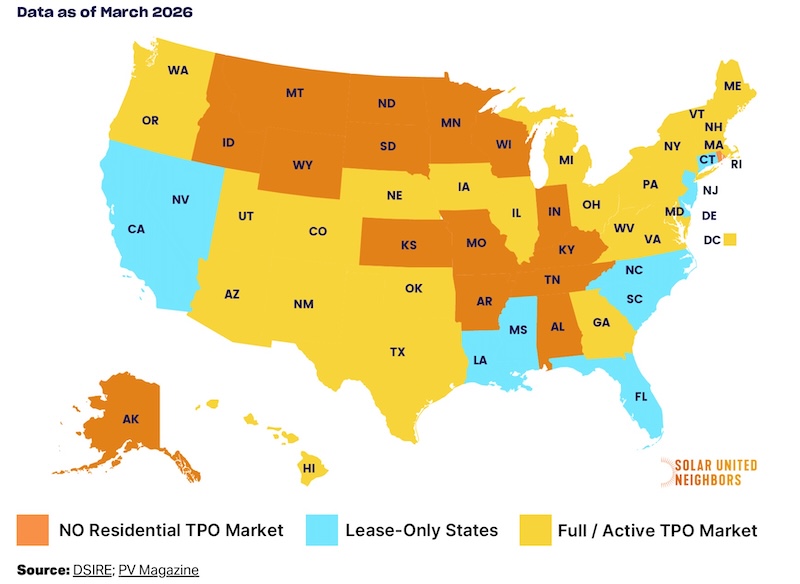
Solar leases and PPAs are not available in every state. The below map shows what is available as of March 2026:
By breaking down complex financing structures into clear, consumer-friendly guidance, Solar United Neighbors aims to empower more households to make informed decisions about going solar.
READ THE REPORT IN FULL AT THIS LINK.
Solar United Neighbors | https://solarunitedneighbors.org/