




Distributed Tension Architectures and the Future of Utility-Scale Solar Structures


Over the past two decades, utility-scale photovoltaic systems have undergone significant structural evolution. Fixed-tilt arrays gradually gave way to single-axis tracking systems, enabling substantial improvements in energy yield and project economics. Today, centralized torque-tube architectures dominate much of the utility-scale tracker market and have helped accelerate solar deployment worldwide.
As solar increasingly becomes critical infrastructure, however, structural requirements are expanding beyond energy production alone. Utility-scale projects now face growing exposure to extreme weather events, increasingly complex terrain conditions, labor and installation constraints, long-term operational maintenance demands, and pressure to improve lifecycle resilience while continuing to reduce costs.
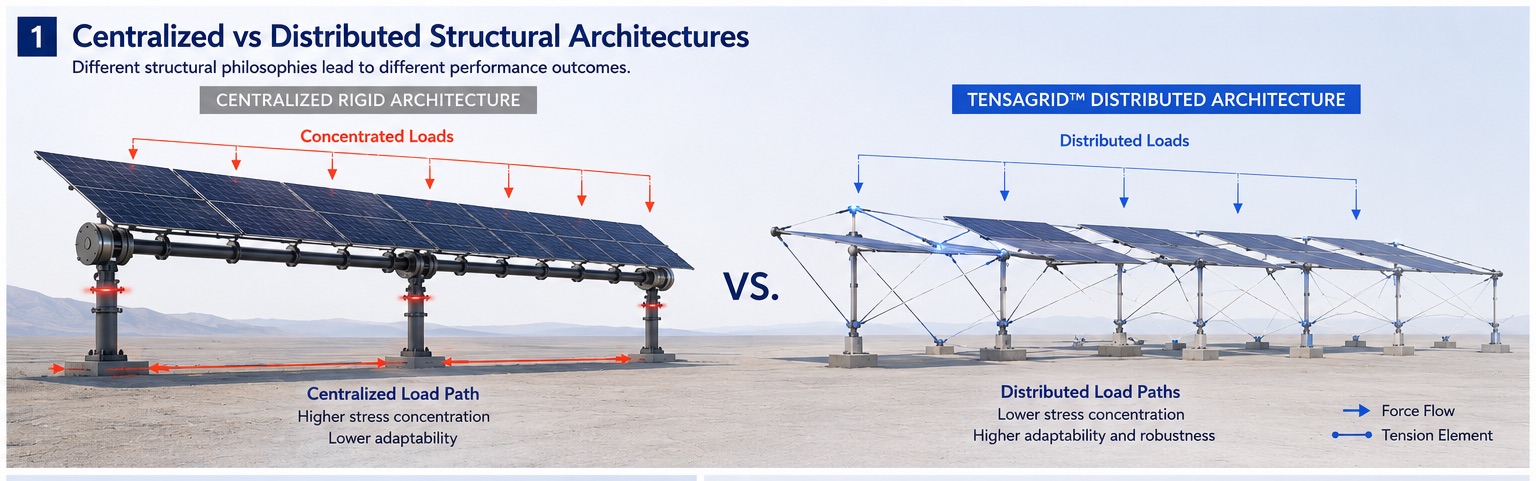
These changing conditions are beginning to expose some of the limitations inherent in highly centralized structural systems.
Traditional tracker systems typically rely on large continuous structural members, centralized mechanical load paths, and rigid structural behavior to maintain alignment and resist environmental loading. While highly effective in many deployment scenarios, centralized rigid architectures can also concentrate structural stresses, increase dependence on large mechanical components, and create broader system sensitivity to localized failures or transient loading events.
As deployment scales continue increasing, interest is emerging around more distributed structural approaches that may offer greater adaptability and survivability under variable real-world operating conditions.
One area receiving increasing attention is the application of distributed tension-based structural principles within photovoltaic support systems.
Tension structures have long been utilized in bridges, aerospace engineering, stadium roofs, and lightweight architectural systems because of their ability to efficiently distribute loads while minimizing material concentration. Unlike purely rigid systems that primarily resist forces through stiffness alone, tension-based structures can allow controlled structural flexibility within defined limits, helping dissipate transient energy and redistribute loading more dynamically across the system.
This distinction may become increasingly important as utility-scale solar projects encounter larger environmental loads and more demanding operating environments.
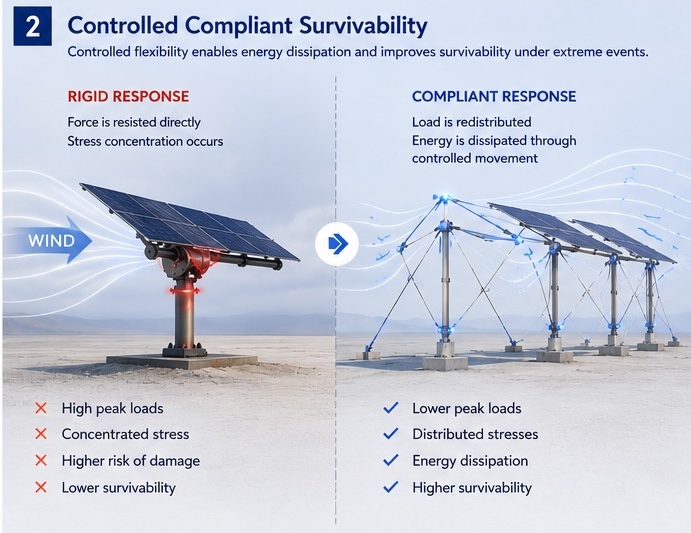
In many natural systems, survivability is achieved not through maximum rigidity, but through controlled adaptability. Similarly, distributed structural systems may allow photovoltaic arrays to absorb and redistribute environmental forces more effectively, rather than concentrating stress at a limited number of highly rigid structural points.
From an engineering perspective, controlled compliant behavior can potentially provide several advantages for future solar deployment systems.
Distributed load paths may reduce localized stress accumulation and improve overall structural efficiency. Tension-based geometries may allow lighter structural configurations while maintaining strength and stability. Controlled flexibility may also improve survivability under transient wind loading by enabling limited structural movement combined with distributed energy dissipation, rather than relying solely on increasing rigidity and material mass.
These approaches may also create opportunities for improved terrain adaptability. Traditional large-scale tracker systems often benefit from relatively uniform site conditions and may require substantial grading in more complex environments. Distributed structural systems, by contrast, may offer greater flexibility across uneven terrain while reducing dependence on large continuous structural members.
Modularity represents another important consideration. As utility-scale solar continues scaling toward increasingly larger deployments, long-term maintainability and field serviceability are becoming more significant operational concerns. Distributed modular architectures may simplify installation sequencing, reduce dependence on heavy equipment during maintenance operations, and enable more localized component replacement strategies.
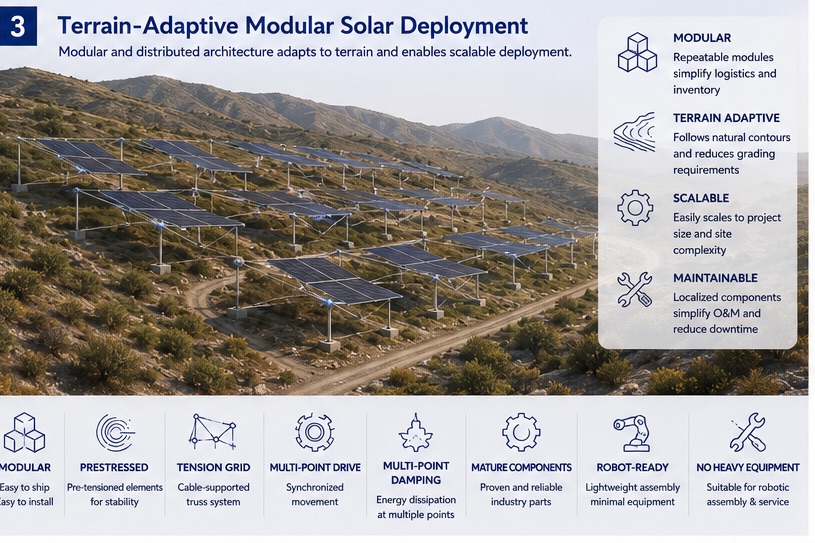
The continued evolution of solar deployment may also increasingly intersect with automation and robotic installation technologies. Lightweight modular structural systems with distributed interfaces could potentially support more automated deployment methodologies in the future, particularly as labor availability and construction scalability become larger industry concerns.
Importantly, these emerging structural concepts do not necessarily represent a replacement for existing tracker architectures. Rather, they may represent an additional direction in the broader evolution of photovoltaic infrastructure design. Different deployment environments may ultimately benefit from different structural philosophies depending on site conditions, environmental loading, project scale, operational priorities, and long-term maintenance strategies.
As utility-scale solar matures into one of the foundational infrastructures of the global energy system, the structural architecture of photovoltaic deployment systems may become an increasingly important area of innovation. Future evaluation of solar structures may extend beyond initial capital cost and energy yield to include survivability, adaptability, maintainability, deployment scalability, lifecycle operational resilience, and structural efficiency under increasingly dynamic environmental conditions.
The evolution from highly centralized rigid mechanical systems toward more distributed structural architectures may ultimately become part of the next stage in the maturation of utility-scale solar infrastructure.
Jian Yuan, PhD, is a photovoltaic structural systems developer focused on next-generation solar deployment architectures, including distributed structural systems, modular photovoltaic integration, and tension-based support structures.
ModuRack | www.modurack.com
Author: Jian Yuan, PhD
Volume: 2026 July/August