




Closing the Soft-Cost Gap


Building or operating energy infrastructure today entails managing more complexity with fewer people. Fueled by the data center buildout and rising energy demand, operators face long interconnection queues, greater project volume and scale, and an increasingly complex regulatory environment. At the same time, the skilled energy workforce is retiring faster than it can be replaced – for every 2.4 workers nearing retirement in the power sector, only one is entering. The industry will need more than 750,000 new workers by 2030.
As the energy transition continues to scale, the labor bottleneck has become an increasingly important target for software. Traditional digital tools have helped at the margins, but AI represents a larger opportunity to relieve pressure on constrained energy workforces. Acting as a force multiplier, AI can empower existing teams to manage larger, more complex assets with greater reliability and lower cost.
Labor-related soft costs are ripe for AI transformation
On a typical energy or industrial infrastructure project, labor makes up between 25 and 50 percent of total project costs. Design, engineering, permitting, compliance, commissioning, and other labor-intensive workflows are expensive and highly fragmented. Many digital tools address individual parts of these workflows, but few work across the full project lifecycle to reduce the delays, rework, missed handoffs, and budget leakage that emerge between systems. This is where AI can bring value by acting as the connective tissue across these silos, especially as projects reach unprecedented scale.
In utility-scale solar, for example, project sites that were often 50 to 100 acres a decade ago are now frequently measured in the hundreds of acres, with many reaching 700 acres. Whereas manual inspection and oversight was once a challenge, now it is virtually impossible. Today, AI-enabled aerial imagery, computer vision, and project intelligence allow a single user to monitor site progress, identify issues, and coordinate next steps.
Additionally, as AI is embedded into these systems, project data can be transferred across teams more easily and accurately. What once required significant labor hours for data entry, communication, and coordination can now be automated and delegated to AI agents, enabling skilled workers to focus on higher-value work.
AI tools also support knowledge transfer, which becomes increasingly important as a new generation enters the workforce. By automating data capture and management, AI enables more reliable systems of record across projects. As work changes hands, training and onboarding can happen faster and more seamlessly, translating into greater productivity and output.
The energy industry has been here before
AI adoption in energy infrastructure is still in its early innings. Survey data suggests about 27 percent of AEC professionals currently use AI in their work. Among those who do, 94 percent plan to expand usage in 2026. The narrative of AI integration in labor-intensive industries is often accompanied by concerns about job displacement. In energy, we see a different pattern emerging: AI as a workforce enabler that will help the industry meet the demands of modern infrastructure buildout.
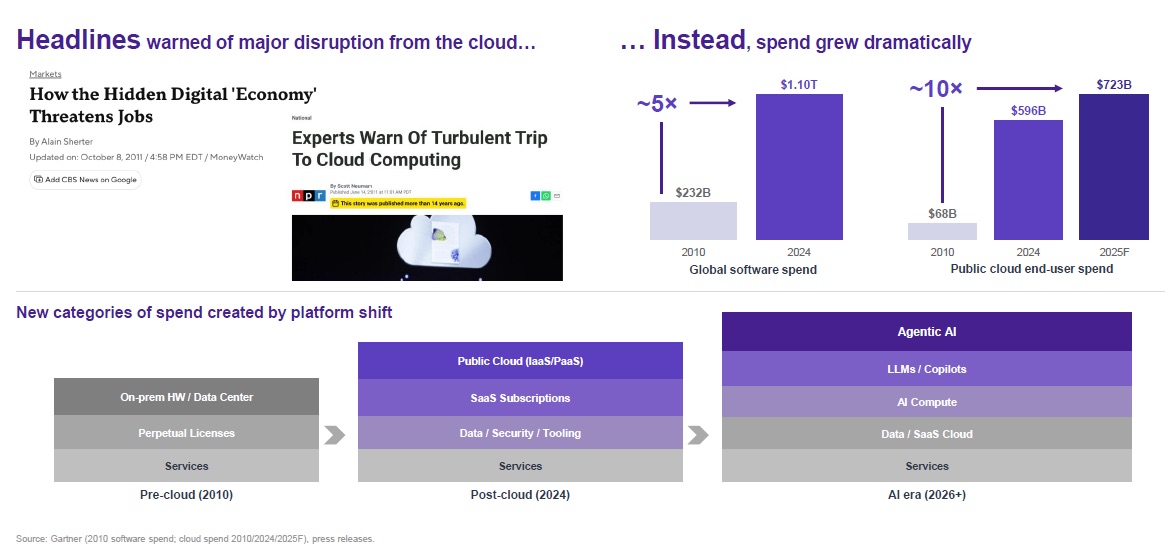
The energy industry has undergone major platform shifts before. When cloud computing was widely adopted in the 2010s, paper-based workflows were replaced with digital tools across energy infrastructure operations. In solar, for example, manual design and engineering processes migrated to the cloud. That shift prompted similar concerns, but the result was not simply fewer people doing the same work. Instead, digitization enabled teams to move faster, manage more complexity, and ultimately support a larger market.
New budget categories emerged, and the industry unlocked new levels of scale as efficiency improved and costs came down. Our estimates indicate that software spend associated with these workflows increased by 3 to 10 times as a result of this platform shift. We anticipate a similar pattern in the AI era.
How AI expands the role of digital solutions
There is a clear opportunity for AI to improve productivity and scale across the labor-constrained energy industry. By pairing AI with existing software and services infrastructure, these systems become more connected, efficient, and useful for the teams responsible for building and operating energy assets. We see this evolution in three phases:
First, AI begins connecting workflows that have historically operated in silos. Design and engineering platforms, permitting automation tools, grid compliance systems, and construction project management software are all data-rich, but they are not always efficient at processing and sharing information across an organization or project. AI tools can aggregate, organize, and analyze this information so teams can work more productively across workflows.
Second, that impact shifts from individual workflows to the broader organization. A tool that helps one team work faster is useful, but a tool that changes how a project team, asset owner, or developer operates end-to-end delivers much greater value. Embedded across the organization, these solutions become more durable, harder to work around, and more directly tied to high-value outcomes: projects delivered on time, assets performing as expected, and compliance maintained with fewer resources.
Third, when software is influencing outcomes at that scale, including avoided downtime, faster interconnection approvals, and better asset dispatch, the commercial model can shift from seats- or usage-based pricing to outcomes-based. In this way, AI is fundamentally changing how software and software-enabled services are deployed and capture value within energy and industrial infrastructure.
Powering the next generation of energy infrastructure
The energy transition is the most labor-intensive infrastructure buildout of our generation, and the teams executing it are facing more pressure and complexity than ever before. Regulatory scrutiny, rising energy demand, and a thinning workforce are compounding pre-existing labor bottlenecks. Traditional software tools have addressed this challenge in a limited way, but AI can go further. For developers, operators, and asset owners navigating modern energy infrastructure, AI can help close the labor soft-cost gap by enabling greater speed, scale, and efficiency across assets and workforces.
 Kevin Stevens is Partner, Co-Head of Endurance at Energize Capital. Primarily responsible for managing Energize’s Endurance strategy, Kevin brings more than a decade of experience in energy and renewables, with roles spanning business development, product marketing and finance. Prior to joining our team, he was a founding partner at Intelis Capital, an early-stage venture firm focused on energy transition and climate change startups. Before becoming an investor, Kevin spent three years on the operating side at Choose Energy, the largest online energy marketplace in the U.S. He was one of the first employees at Choose, and as head of product helped guide the company through several fundraising rounds and eventually an exit in 2017. Prior to that, he began his career at NRG where he held roles in business development and finance. Kevin holds an MBA from Southern Methodist University and a B.A. in political science from the University of North Texas. He currently serves as a board director for Sitetracker and a board observer for PVcase and 5.
Energize Capital | energizecap.com
Author: Kevin Stevens