




The Hidden Risk in Your Battery Storage System: Why cable cleats belong in every BESS specification


Fire risk tops the headlines, but short circuit events may be the more immediate threat on your next project.
Battery energy storage systems (BESS) are having a moment. After years of promise, the technology has reached an inflection point thanks to plummeting costs, utility-scale deployments, and continuing federal support. BESS has earned its reputation as the sector to watch by solving difficult grid problems.
But momentum has a way of outpacing caution. The safety conversation in the BESS industry has been dominated, understandably, by thermal runaway and fire. What gets less attention is the risk posed by short circuit events and the enormous mechanical forces they impose on cable systems. For engineers and project developers specifying BESS installations, cable cleats are a critical line of defense.
Short circuit protection
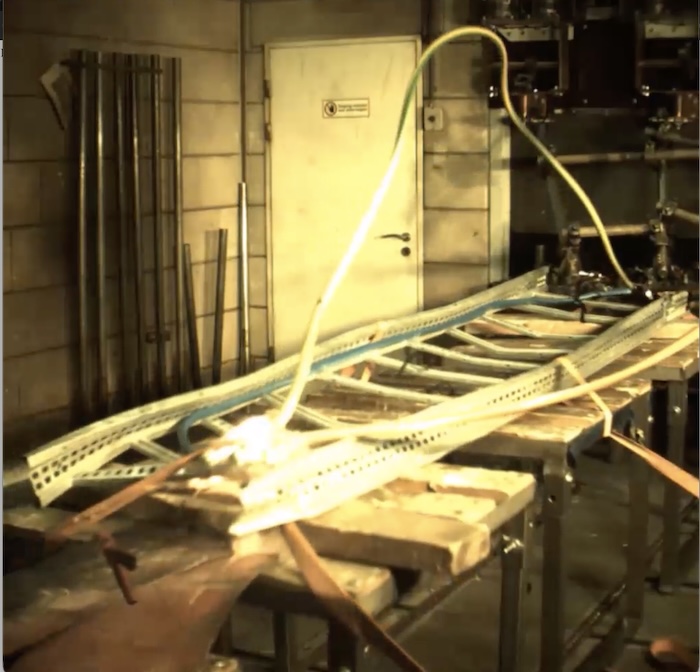 During a short circuit fault, current levels can spike to many times their normal operating value in milliseconds, creating powerful electromagnetic forces between parallel conductors. These forces are repulsive when currents flow in opposite directions and attractive when they flow in the same direction, causing cables to move suddenly and violently. Inadequately restrained cables can whip, clash, and arc against adjacent conductors or equipment, turning a contained electrical fault into a cascading failure that causes far more damage than the original event.
Cable cleats are the answer to this problem. These mechanical fastening devices clamp around cables and anchor them to trays, ladders, or structural supports at regular intervals. Their primary function is to keep cables exactly where they are supposed to be during a fault event, much like a seatbelt restrains a driver in a car accident.
More than a bracket: What cable cleats actually do
It is worth distinguishing cable cleats from other cable management products. A cable tie is not a cable cleat. Cleats are engineered products, tested and certified to IEC 61914, the international standard governing their performance under fault conditions.
Selecting the right cleat starts with knowing your fault current. The forces on a cable during a short circuit scale with the square of the current, so small differences in available fault current translate into dramatically different mechanical demands on the cable cleat system. IEC 61914 defines test categories based on peak fault current levels, giving engineers a path from calculated fault current to a certified product rating.
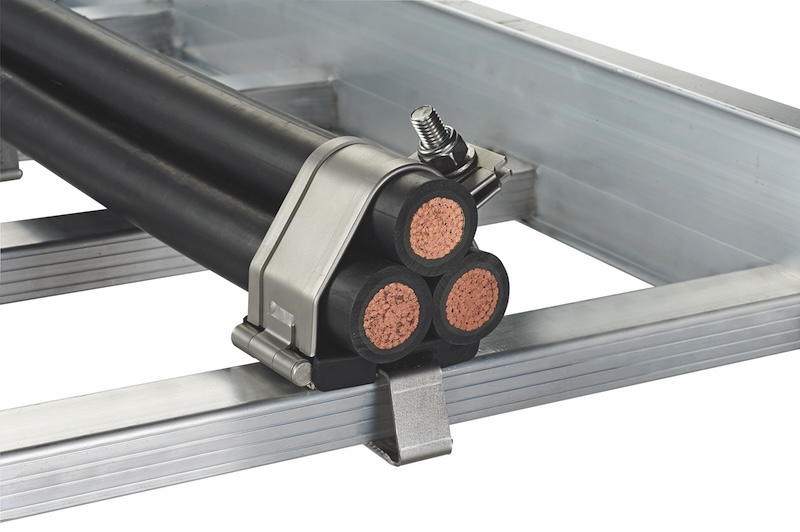
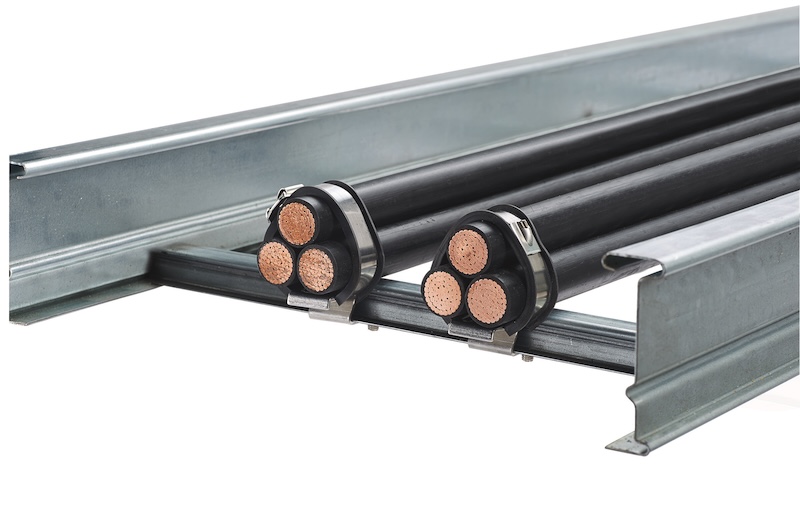
Cleat spacing matters as much as cleat strength. Closer spacing reduces the span over which cables can deflect, lowering the peak force each cleat must absorb. Cable diameter, weight, and the geometry of the installation all enter the calculation.
Two broad families of cable cleats dominate the market. Traditional clamp-style cleats use a rigid body to encircle the cable and bolt to the support structure. They require no special tools and are available in materials suited for corrosive or chemically aggressive environments. Stainless steel is the choice for outdoor installations, while thermoplastic offers electrical non-conductivity and lighter weight where conditions and fault current ratings allow.
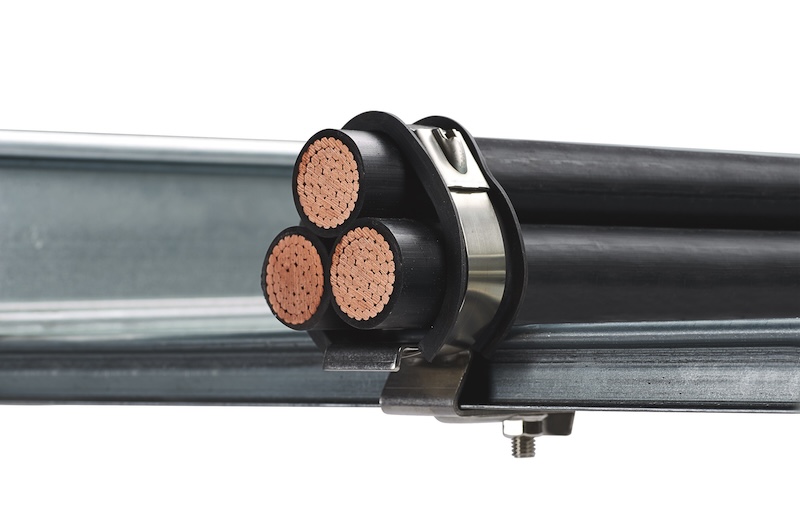
Stainless steel strap cleats are a newer alternative that has rapidly grown in popularity among contractors. Their lower profile and flexible form factor allow much higher installation density, which can be a significant advantage in the tightly packed cable runs typical of BESS enclosures. They install faster and at lower cost per cleat, which adds up on large projects.
The AC/DC problem
Most electrical infrastructure, and most cable cleat standards and ratings, were developed for AC systems. BESS adds substantial DC cabling to the picture, and those circuits behave very differently under fault conditions.
In a three-phase AC circuit, fault current naturally passes through zero multiple times per cycle, giving protection devices a recurring opportunity to interrupt the arc. DC faults have no such natural zero crossing, so fault current can persist at high levels until the energy source is depleted or the protection system forces interruption. DC arcs are generally more sustained and more energetic than their AC counterparts. This has direct implications for the mechanical stress on cables and the cleat systems holding them.
A cleat product validated for an AC fault current environment may not be adequate for the DC cabling in a BESS installation. Engineers should explicitly verify that their selected cleats are rated for the DC fault conditions present in the system and should engage manufacturers with experience in DC applications.
What the code says — and where it falls short
NFPA 855, the Standard for the Installation of Stationary Energy Storage Systems, is the primary installation code governing BESS in the United States. The NEC addresses cable support and spacing requirements in Articles 392, 690, and 706, and IEC 61914 is increasingly referenced in U.S. project specifications.
The current codes do not yet give engineers the explicit, prescriptive guidance on cleat selection methodology that the technology demands. Most leave considerable discretion to the Authority Having Jurisdiction. As the BESS industry matures and incident data accumulates, more prescriptive requirements are likely coming. Specifying to the best available standard — IEC 61914 — and documenting your fault current analysis and cleat selection rationale is both good engineering and good risk management in the meantime.
Specification checklist for BESS projects
Start with a proper short circuit current analysis and account explicitly for DC system characteristics; do not assume AC-rated products are adequate for your battery-side cabling. Factor in the environmental conditions, including high UV and potential exposure to electrolyte residue, to determine the proper cleat material. And work with manufacturers who can provide application engineering support, not just a product catalog. Given the energy levels involved and the cost of getting it wrong, selecting the right cleat on a BESS project is not a commodity decision.
 Andrew Booth is a Business Development Manager (Strategic Growth Programs) at Panduit, based in London, where he leads the global Cable Cleat business unit and drives strategic initiatives within the energy sector. An apprentice-trained draughtsman and engineer, he brings broad industry experience across construction and precision engineering, along with a Master’s degree from the University of York (UK). Andrew is a Chartered Engineer, a Fellow of the Institute of Engineering, and a Senior Member of IEEE, and collaborates globally to support innovation and growth in energy infrastructure.
Panduit | www.panduit.com
Author: Andrew Booth
Volume: 2026 July/August