




Resist the Creep


As solar, battery, and smart-glass technologies advance toward higher efficiencies, longer service lives, and thinner architectures, they operate in regimes sensitive to moisture, oxygen, and organic contamination. Active chemistries in perovskite, tandem, and thin-film photovoltaic modules, high-nickel and lithium-metal cells, solid-state batteries, and electrochromic devices degrade on exposure to trace water, reactive species, or organics leached from surrounding materials. In other words, adhesives and sealants at optical, electrical, and perimeter interfaces exert direct control over service life.
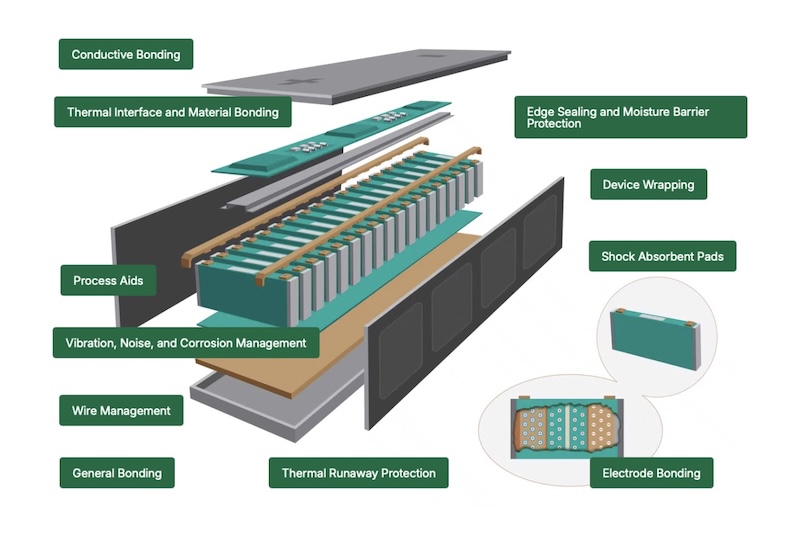
Polyisobutylene (PIB) combines intrinsic hydrophobicity, very low moisture vapor transmission rate (MVTR), minimal outgassing, pressure-sensitive adhesion, flexibility, and chemical inertness. The inertness derives from the absence of reactive functional groups along the saturated hydrocarbon backbone, rendering PIB insensitive to the oxidative, hydrolytic, and ionic degradation pathways that compromise acrylic, urethane, silicone, and functionalized polyolefin systems. Structural simplicity has historically constrained its use: without reactive sites, neat PIB cannot be crosslinked to develop the cohesive strength and elevated-temperature creep resistance required by demanding applications.
A patent-pending high-cohesion PIB platform retains the chemical inertness and barrier behavior of pure PIB while addressing these limitations. It can be configured as an electrically conductive interlayer, a transparent pressure-sensitive film, or a dispensable perimeter seal. Three implementations are summarized below.
Conductive PIB interlayers for battery systems
Interfaces inside electrochemical cells, whether between current collector foils and separators or between electrodes and adjacent layers in emerging architectures, are governed by true area of contact rather than bulk transport alone. Contact resistance, interfacial impedance, and local current concentration scale with the fraction of nominal area in actual mechanical and electrical contact. A compliant interlayer that flows into surface microstructure during lamination increases true contact area and accommodates dimensional change during cycling.
Electrically conductive high-cohesion PIB films at 2 to 25 µm serve this role; 5 µm constructions exhibit through-thickness resistance of ~5 mΩ. The saturated hydrocarbon backbone offers no functionality susceptible to electrolyte-driven degradation, is electrochemically inert within common cell operating voltage windows, and exhibits low electrolyte uptake, supporting stable contact resistance over cycle life.
Neat PIB pressure-sensitive adhesives exhibit a monotonic decline in peel toward 80 °C, where cohesive failure dominates. The high-cohesion conductive platform retains substantial peel at 80 °C, preserving bond integrity at battery operating temperature rather than only under static shear at rest, and suppressing interfacial delamination under cell-level thermal and mechanical loading.
High-clarity PIB encapsulant layers for photovoltaics
Perovskite, tandem, and thin-film modules incorporate moisture-sensitive layers that must be protected throughout service life. Water and oxygen typically reach these layers first through glass/adhesive/film or glass/adhesive/coating interfaces. Conventional film encapsulants such as EVA and POE are processed at 0.4 to 0.5 mm and exhibit MVTR values of ~4 g/m²·day and 15 to 35 g/m²·day, respectively, depending on formulation and test conditions. On a thickness-normalized basis, these correspond to ~2 g·mm/m²·day for POE and >5 g·mm/m²·day for EVA.
The high-cohesion PIB platform delivers thickness-normalized MVTR below 0.25 g·mm/m²·day, a 5-to 100-fold reduction relative to conventional encapsulants. At 0.05 mm, an as-used MVTR near 3 g/m²·day has been measured:
- High-cohesion PIB film (0.05 mm): ~3 g/m²·day
- POE encapsulant (0.5 mm): ~4 g/m²·day
- EVA encapsulant (0.5 mm): ~15 to 35 g/m²·day
Under diffusion-limited transport, MVTR scales inversely with thickness, so a 0.10 mm PIB layer halves MVTR to first order while remaining roughly fivefold thinner than a typical POE sheet. This provides a route to lower water ingress at moisture-sensitive optical interfaces without multi-millimeter bulk layers, which would otherwise increase optical path length and absorption.
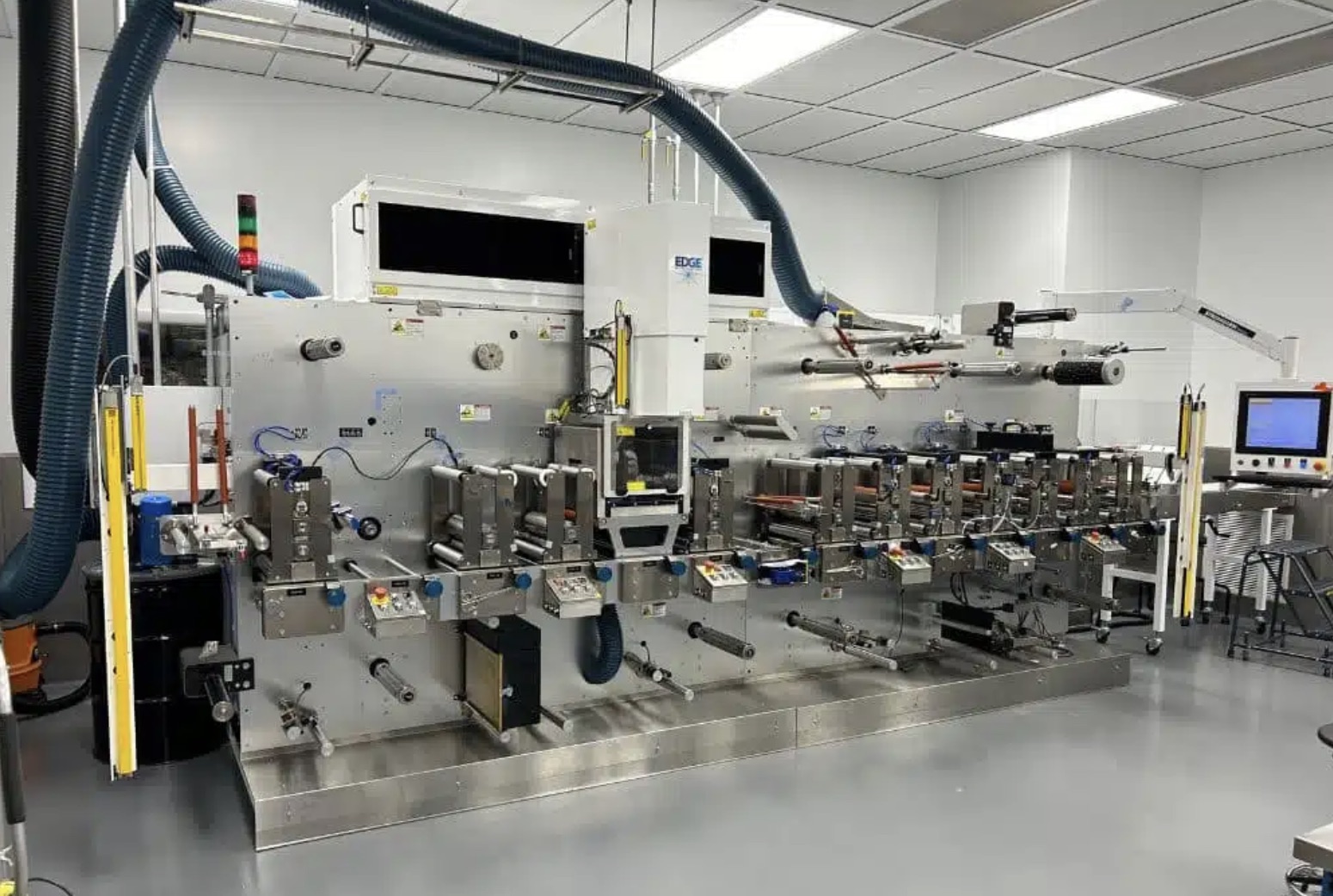
The historical barrier to PIB use in optical stacks has been cold flow under sustained stress at service temperatures. The high-cohesion platform suppresses this behavior. Static shear resistance exceeding 10,000 minutes at 70 °C and greater than 100 minutes at 110 °C has been demonstrated under standard test conditions, supporting positional stability in thin-glass and film-based stacks. Because application requires only pressure rather than thermal lamination, the encapsulation step can be performed at or near room temperature in a roll-to-roll process, reducing thermal exposure for perovskite absorbers, charge transport layers, and functional coatings. These films can also serve as localized barrier reinforcements around busbars, stepped coatings, and embedded components where bulk encapsulant does not fully wet the topography.
Dispensable PIB sealants for perimeter and enclosure seals
Perimeter seals and enclosure beads in photovoltaic modules and battery systems must provide long-term adhesion, low moisture transport, and dimensional stability under temperature and humidity cycling. A dispensable high-cohesion PIB addresses a rheological problem specific to butyl-class sealants: the material must flow reliably through a heated dispenser during application, yet resist slump, sag, and cold flow once in place on a vertical flange or inverted joint at service temperature.
Viscosity and yield behavior are tuned across this window. Above ~160 °C and under shear, the material flows through standard hot melt equipment (process temperatures typically 130 to 200 °C), allowing controlled bead geometry, wetting, and open time. Conventional butyl sealants that flow at process temperature also exhibit measurable cold flow at service temperature; the high-cohesion network suppresses the second behavior without sacrificing the first. The dispensable implementation also retains peel at battery-relevant temperatures, unlike neat PIB whose adhesion falls as the joint warms. Combined with minimal low-molecular-weight volatiles, this limits joint creep, condensable buildup at optical interfaces, and extractable contamination in electrolyte-containing enclosures.
Conclusion
The sensitivity of next-generation clean energy devices to moisture, oxygen, and chemical contamination has exposed limitations in adhesive systems built on reactive or highly functionalized chemistries. The high-cohesion PIB platform preserves the inertness and low permeability of pure PIB while introducing the mechanical stability required by these architectures. Configured as thin conductive layers, optical barrier films, or dispensable perimeter seals, the same chemistry can be directed at the interfaces that most strongly govern device reliability.
Tyson Davis is Innovation Group Leader – Electronics at Adhesives Research, which provides connectivity, thermal management, and moisture barrier protection to critical electronics segments, including Electric Vehicle (EV) Battery production.
Adhesives Research | www.adhesivesresearch.com
Author: Tyson C. Davis, Ph.D.
Volume: 2026 May/June