




How Next-Gen Edge Gateways Empower the Grid Edge


In the North American power market, Demand Response (DR) is no longer confined to large industrial facilities turning off heavy machinery during peak hours. Driven by FERC Order 2222 and the rapid deployment of distributed energy resources (DERs), behind-the-meter C&I solar and Battery Energy Storage Systems (BESS) are increasingly relied upon to provide active grid support.
Modern utility programs and Virtual Power Plants (VPPs) require C&I assets to act as dynamic grid citizens. This entails executing real-time autonomous functions:
- Dynamic Curtailment & Power Export/Import Limits to manage localized grid congestion.
- Volt-Var / Volt-Watt reactive power compliance at the Point of Common Coupling (PCC) to stabilize voltage.
- Coordinated solar + storage dispatch to maximize economic returns under complex Time-of-Use (TOU) tariffs and demand charge management.
However, EPC contractors and system integrators frequently encounter significant roadblocks. C&I project sites often deploy string inverters from various original equipment manufacturers (OEMs), legacy communication protocols with high latencies, and complex field wiring challenges. Without an advanced localized controller, transforming these heterogeneous assets into a compliant, dispatchable DR resource is a monumental task.
Overcoming the communication bottleneck
Speed and reliability are the cornerstones of grid-interconnection and DR program enrollment. Many legacy string inverters in the field exhibit a local Modbus RTU command cycle exceeding 500 milliseconds. When coupled with the internal execution lag of the inverter's digital signal processor (DSP), the total response time fails to meet the strict telemetry and fast-curtailment windows required by forward-looking utilities.
1. Hardware-Accelerated Concurrency via Data Adapters
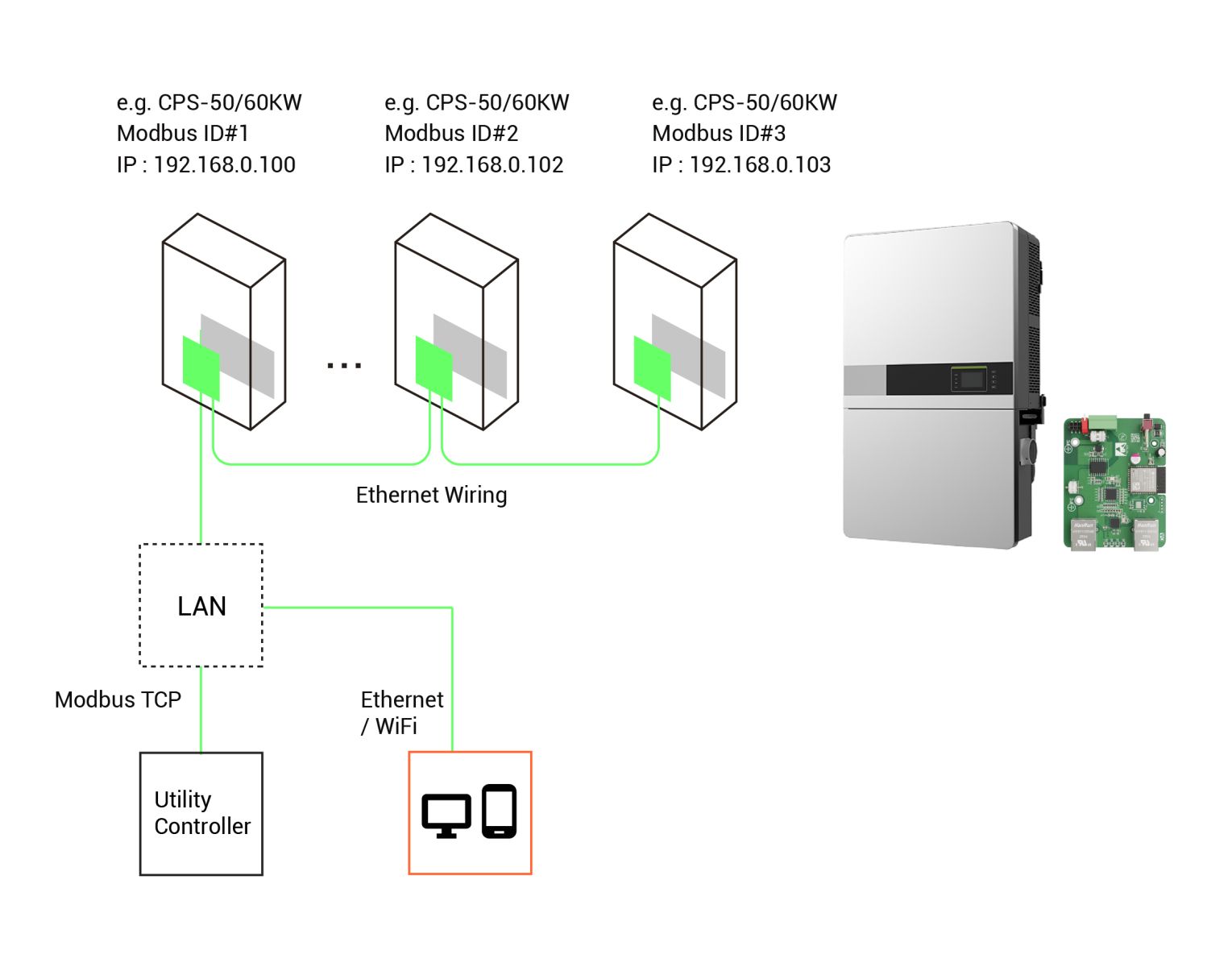
Advanced edge architectures eliminate this latency through a cost-effective digital upgrade. By installing a dedicated data adapter directly onto the inverter, the local communication protocol is instantly converted from Modbus RTU to Modbus TCP. This enables the Utility Controller to issue concurrent commands across the asset array, slashing the average command cycle to a mere 50 milliseconds. This level of concurrency ensures that large-scale C&I arrays can respond to aggregation signals simultaneously.
2. Eliminating Field Noise: High-Reliability Local Bus Networks
On expansive commercial rooftops or carports, long RS485 runs are notorious for electromagnetic interference, leading to packet loss and dropped DR events. Integrating an intelligent communication board and nesting a compact edge gateway directly within the inverter wire box solves this issue. The system automatically discovers all downstream devices and actively suppresses bus noise over robust physical layers (such as CAN, UDP, or TCP).
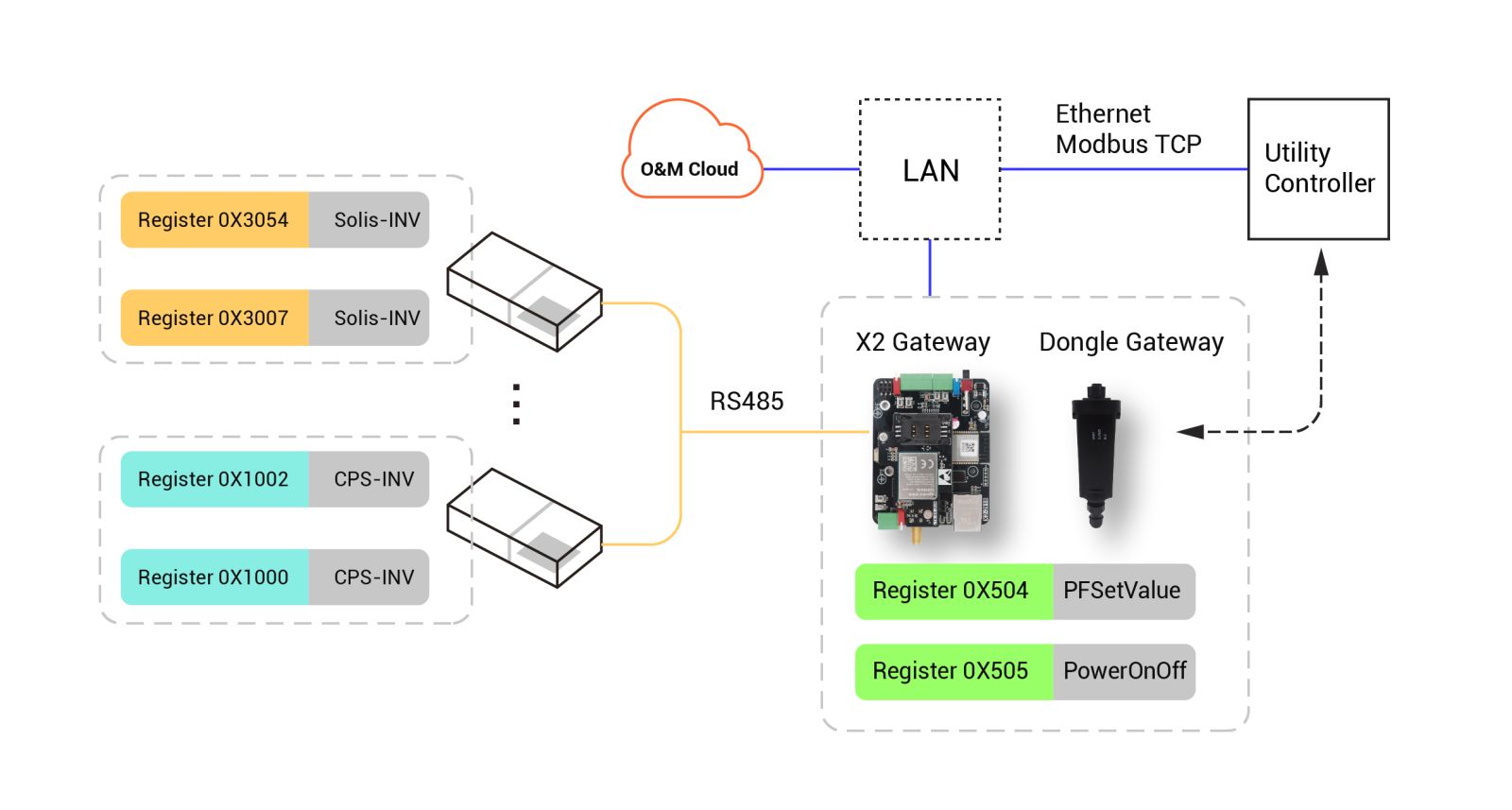
Crucially for North American operators, this architecture allows third-party SCADA systems to poll data via Modbus TCP Pass-thru while simultaneously permitting the primary operations and maintenance (O&M) cloud to monitor the site over a parallel path. This guarantees that utility telemetry and operational asset management never compete for bandwidth.
3. Unified Register Mapping for Heterogeneous Arrays
A major headache for system integrators is managing mixed-brand fleets. A single C&I portfolio or even a single site might combine inverters or BESS units from various manufacturers.
Modern edge gateways resolve this complexity through Unified Register Mapping. The Utility Controller or VPP Aggregator interacts with a single, standardized set of registers on the gateway (e.g., Active Power, Reactive Power, and Power Factor setpoints). The gateway's local operating system handles the translation into OEM-specific registers in real time. By virtualizing multiple physical inverters into a single, cohesive logical entity, top-level dispatch software can treat the entire site as a synchronized power plant.
4. Scalable Master/Distributed Architecture
For large-scale utility-interactive projects, a single gateway's physical port capacity can limit system throughput. High-performance topologies resolve this by pairing a centralized Master Gateway with multiple distributed edge controllers. Operating over a localized fiber or Ethernet LAN, the Master coordinates separate Modbus TCP channels for each sub-daisy chain. This master/distributed topology scales to support over a hundred inverters while strictly maintaining the sub-second command response intervals demanded by regional transmission operators (RTOs).
Localized power control systems
To qualify for lucrative grid service programs, a C&I facility needs a powerful, localized "brain" capable of executing multi-quadrant power adjustments. Integrating native Power Control System (PCS) technology into the edge gateway provides the necessary computational power.
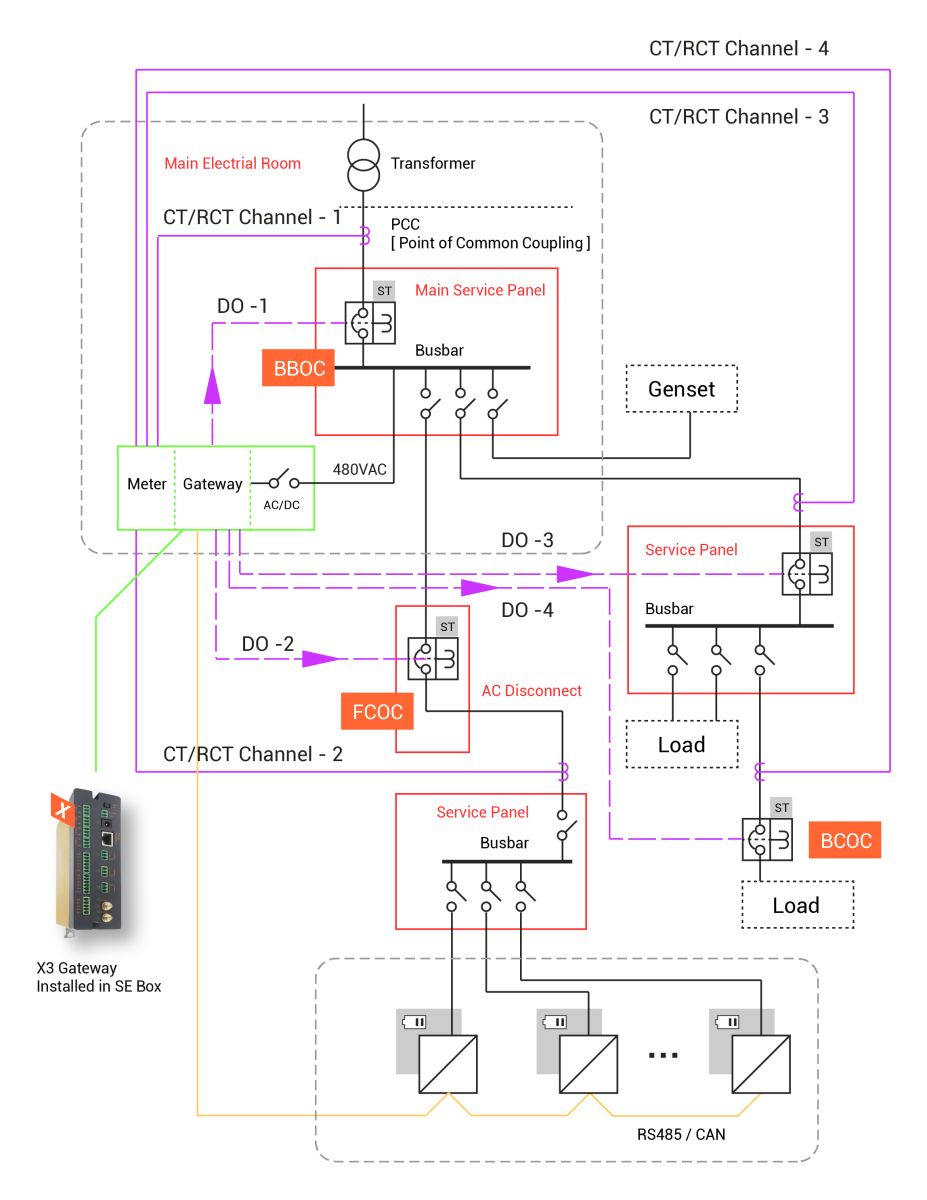
- Hard "Zero-Export" (anti-backflow) control: In many regions, securing an interconnection agreement requires strict non-export or limited-export compliance (such as Net Energy Metering integrity modes). The edge gateway continuously samples power dynamics at the PCC via Revenue Grade Meters (RGM). It dynamically throttles solar output in real-time to match sudden building load drops, ensuring that zero power is back-fed into the utility grid.
For multi-building corporate campuses where trenching RS485 cable is physically or financially impossible, separate building arrays can sit on a common local VLAN. This setup executes synchronized zero-export mitigation via a single master gateway over the facility's existing network infrastructure.
- Avoiding expensive utility transformer upgrades: When retrofitting an existing commercial facility with BESS for demand charge clipping or DR participation, the existing main electrical panel busbar rating often becomes a bottleneck. Upgrading utility transformers and service panels can derail project economics.
Integrated edge solutions (utilizing UL-listed control enclosures) mitigate this by dynamically adjusting the BESS charging ramp relative to immediate building loads. This ensures that the combined current on the AC busbar never exceeds rated thresholds, completely eliminating the need for capital-intensive infrastructure upgrades.
- Hardware-enforced overload protection: Software-based curtailment alone often falls short of the rigorous safety mandates imposed by certain Independent System Operators (ISOs). To address this, specialized intelligent gateways monitor busbar metrics via multi-channel current transformers (CTs). If an absolute overload threshold is breached, the gateway goes beyond software commands; it utilizes onboard Digital Outputs (DO) to trigger the shunt trip of the main or sub-service circuit breakers, physically isolating solar generation or non-critical loads to preserve asset integrity.
The ultimate fail-safe line of defense
In utility-directed demand response, communication failure represents a severe operational liability. If a localized gateway loses connection with the VPP aggregator or the primary utility controller while operating at maximum output during a grid emergency, the resulting localized overvoltage or back-feeding can lead to heavy utility penalties or equipment damage.
To mitigate this, next-generation gateways incorporate an automated, hardware-enforced Fail-Safe Mechanism:
- Instantaneous loss-of-comm response: If communication drops between the inverters and the gateway, the meter and the gateway, or the external utility controller and the gateway, the system executes an immediate, pre-configured fail-safe protocol — either forcing an automated system shutdown or ramping down to a safe, pre-approved derated output.
- Multi-condition interlocking: External dry contacts or utility-driven Digital Inputs (DI) can be wired directly into the edge controller, allowing local grid state changes or automated safety flags to trigger an immediate shunt trip, safely isolating the PV array or specific loads within milliseconds.
This predictable, automated fallback behavior gives North American utilities the confidence needed to approve distributed assets for high-stakes grid service programs.
Conclusion
As North American power markets march toward higher frequency, localized capacity, and ancillary service programs, distributed C&I solar and storage must transition from static generation to highly agile assets. Backed by a robust "Edge Gateway + Cloud Platform" architecture, hardware-agnostic solutions provide EPCs, system integrators, and project developers with a single, standardized toolkit to conquer complex PCS scenarios.
From localized hardware diagnostics and multi-tenant O&M access control to pre-packaged cellular connectivity options tailored for major North American carriers, intelligent edge gateways remove the friction from DER aggregation. Turning erratic grid-edge nodes into highly responsive, UL-compliant, and virtualized grid assets is no longer a futuristic goal — it is a current operational standard.
Howard Young is a Product Manager at FOMware, which provides solutions in the form of “Edge Gateway + Cloud Application” for the global renewable energy market.
FOMware | www.fomware.com
Author: Howard Yang
Volume: 2026 July/August