




Modern-Day Alchemy: Wastewater to green hydrogen


The remarkable thing about the emerging hydrogen economy is how many objections are given and from so many different angles as for why it can’t happen.
There are two major components required to make green hydrogen through the electrolysis process: energy and water.
One of the most frequently repeated falsehoods is that you can’t effectively make hydrogen except where ample fresh water supplies exist. However, what many don’t know is that, when paired with sun and/or wind, wastewater is a perfectly viable alternative to fresh water when resources are not abundantly available.
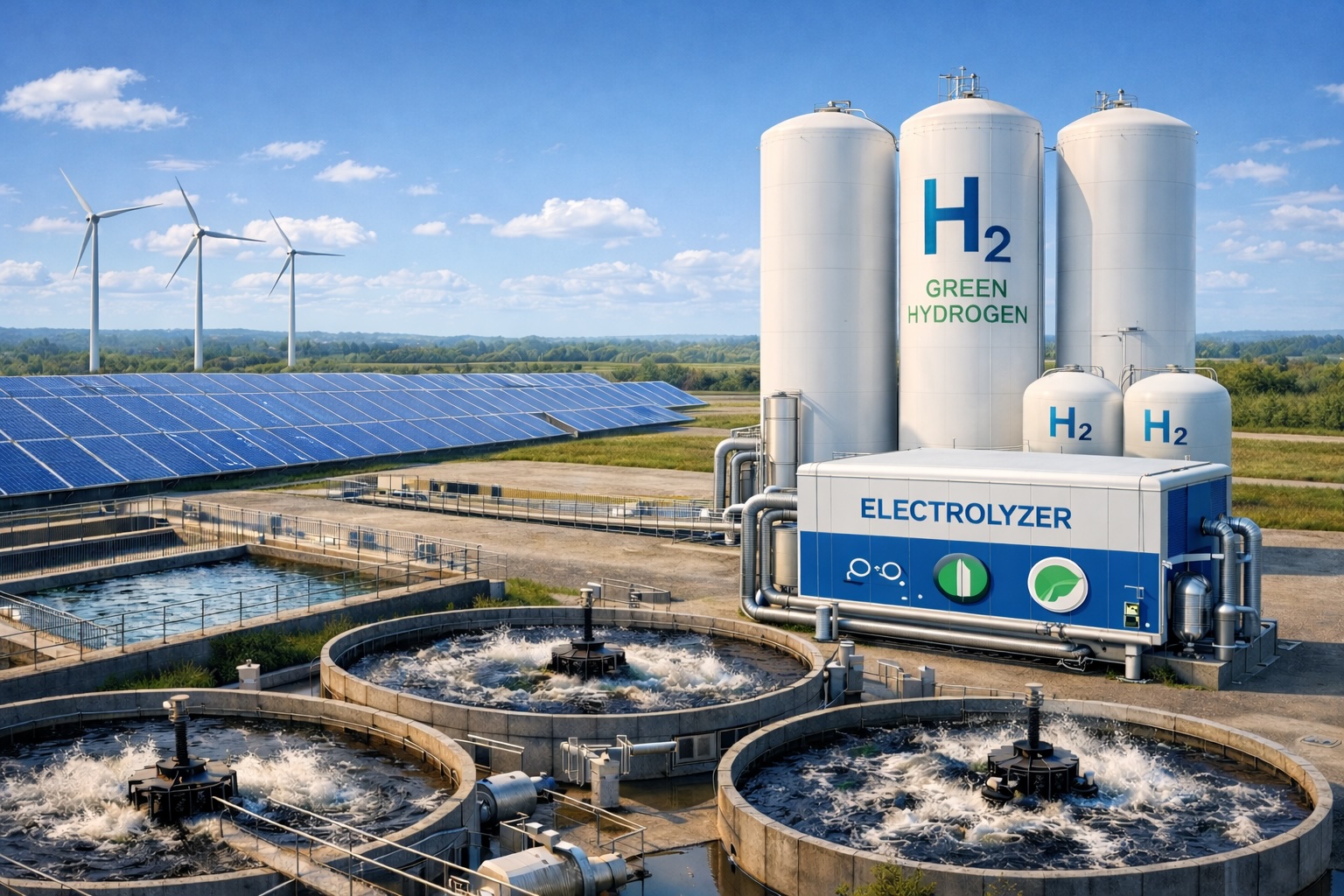
California’s hidden asset: High-quality wastewater
It takes between 2.5 and 8 gallons of water per kilogram (kg) to make hydrogen. We’ll use 5 here to account for differences in efficiency across locales. Based upon this, with enough solar energy, the Inland Valley of California can produce abundant quantities of hydrogen even during drought conditions. Let’s explain how.
Manufacturing hydrogen through electrolysis requires clean water. California has some of the highest water purity standards in the world. In many parts of the State, water that is discharged into the ocean or common waterways, or injected into groundwater aquifers, must be suitable for drinking. Water at that standard of cleanliness is not very far from the level of purity required for hydrogen production. In fact, with very little additional processing, that water can be used in electrolyzers to create green hydrogen.
Case study in scalable hydrogen production
Given the abundant solar energy in a place like Fresno, there will be no problem getting very inexpensive electricity at less than 4¢/kWh. The amount of water being discharged in Fresno alone totaled 21,300,000 gallons per day. Assuming the 5 gallons of water referenced to make one kg of hydrogen, Fresno could be creating 4,260,000 kg of hydrogen a day. That’s enough to fuel a fleet of 1,065 vehicles to drive a total of 388,725 miles per day. Which means that even if they fuel a fleet of vehicles with hydrogen they make in the town, there would be plenty left over for sale to the general public. In addition, the smaller adjacent towns of Visalia and Tulare discharge 3,120,000 and 2,750,000 gallons per day into the ground. Converted into hydrogen, that amounts to 624,000 kg/day and 550,000 kg/day, respectively. Taken all together, the Fresno-Visalia-Tulare tri-city area could produce a total of 5,178,260 kg per day of hydrogen gas.
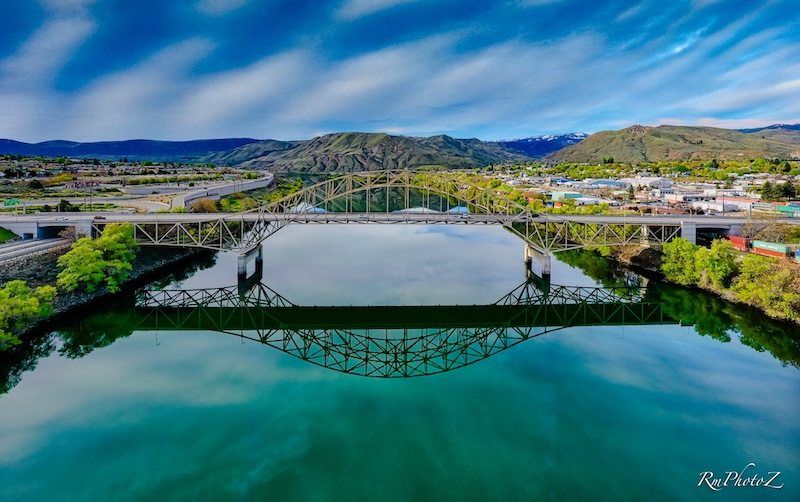
Proof of concept: What East Wenatchee already shows us
To give an example of how lucrative this hydrogen production would be for the tri-city area, it costs the East Wenatchee community $4/kg to make the hydrogen using excess power from the local Douglas County Public Utility District (PUD) Wells Hydroelectric dam and water from the Columbia River that flows through town. The small Douglas PUD built a 5 MW electrolyzer so they could fuel the Sheriff’s Toyota Mirai, a hydrogen bus, and a small fleet of PUD vehicles. Even with that, they have plenty left over that they sell to the public! The theory behind this novel, low-tech, small-scale project was to provide greater grid stability by being able to channel excess power to their electrolyzer. The utility avoids repeated cycling of its generation equipment, thereby smoothing out the load demand curve to create a controllable load that can respond dynamically to grid conditions. Those additional tools for evening out load demand result in lower maintenance demand on the hydro plant, improved grid stability, and a steady source of hydrogen for municipal use or for sale. In addition to the benefits from better control of the grid load from the dam, the hydrogen East Wenatchee uses and sells for $4/kg is an incredible value to the town.
Waste stream to revenue stream
California is currently charging up to $29.99/kg for hydrogen at the pump. The average cost to the public is slightly less, so let’s assume the average cost at the pump statewide is $25/kg. Let’s be more conservative and choose $6/kg for the price Free on Board (FOB) in Fresno. At that price, the Fresno-Visalia-Tulare tri-city area could achieve daily gross sales of $7,069,560 at the pump (minus delivery charges if the off-taker wanted delivery at another location).
Finding gold in what we throw away
The amount of money at stake here is truly remarkable. It is reminiscent of all the school districts in California that didn’t want to install solar arrays in their parking lots until they understood how much they could save in electricity costs — at which point, there was a stampede to install the arrays. When the wastewater disposal districts in California realize how much money they can make from the excess wastewater they process, they’ll begin to yell the State motto: “Eureka.” There really is gold in that “waste” product.
 Rinaldo S. Brutoco is founding president and CEO of the World Business Academy, and a successful entrepreneur, executive, author, radio host, and futurist. He has published numerous cutting-edge articles and books that address the role and responsibility of business in relation to the critical moral, environmental, and social concerns of the day. He is a regular keynote speaker at conferences and guest lecturer at business schools such as Stanford Business School, the Columbia Graduate School of Business, the Kellogg Graduate Business School at Northwestern University, and the Keenan-Flagler Graduate School of Business at North Carolina University. For over 35 years, Rinaldo has been widely recognized as a practical visionary and change agent.
World Business Academy | worldbusiness.org
Author: Rinaldo S. Brutoco