




Controlled Liquid Hydrogen Storage: The backbone of decentralized energy


Energy transition is entering a new phase, defined less by how energy is generated and more by how it is stored, managed, and delivered. As energy systems become increasingly decentralized, the ability to provide reliable, high-density, long-duration storage is emerging as a foundational requirement — not an optional capability.
Across utilities, industrial operations, ports, transit agencies, and data centers, the pressure is mounting to balance rising electricity demand with the variability of renewable generation and the growing grid constraints.
In this environment, hydrogen is gaining traction not only as an alternative fuel but also as a strategic energy carrier. Within that landscape, controlled liquid hydrogen storage is emerging as a critical enabler of decentralized energy infrastructure.
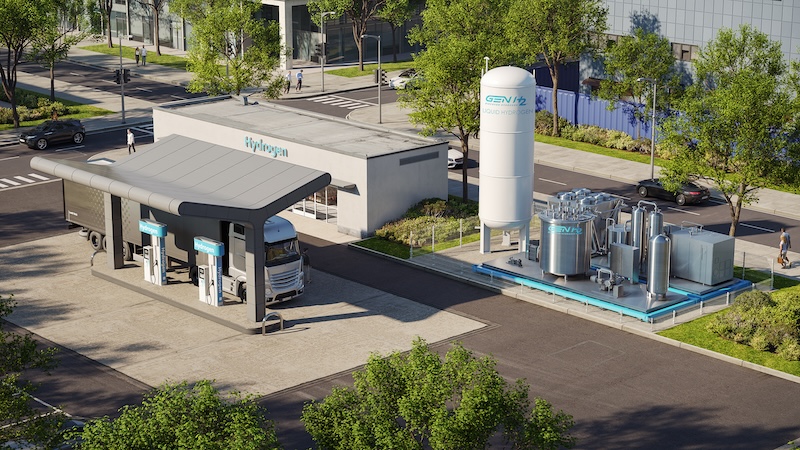
Hydrogen’s value as a clean energy carrier is well established. Excess renewable energy can be converted into hydrogen and stored for later use in power generation, transportation, and industrial operations. Unlike traditional battery systems, hydrogen enables long-duration and even seasonal energy storage at much larger scales.
But scaling hydrogen infrastructure efficiently requires solving one critical issue: storage.
Why decentralized energy changes the equation
Traditional energy systems were built around centralized generation and long-distance transmission. Today, energy resources are increasingly decentralized and located closer to where they are used, through microgrids, renewable installations, and localized energy systems.
This evolution is creating a structural need for energy storage to balance intermittent renewable generation with real-world demand.
Batteries will remain vital, especially for short-term storage. Yet, numerous applications require higher energy density, extended storage durations, and increased scalability, which batteries alone cannot offer.
That is where hydrogen becomes increasingly valuable.
Hydrogen enables the storage of renewable energy generated during off-peak periods for use during peak demand, outages, or grid stress events. It also offers flexibility across multiple sectors, including transportation, industrial operations, backup power, and grid stabilization.
However, not all hydrogen storage methods are equally suited for decentralized infrastructure.
The advantage of liquid hydrogen
Gaseous hydrogen systems require high-pressure storage, larger footprints, and more complex compression infrastructure. These constraints can pose operational and economic challenges in space-limited environments such as transit depots, ports, industrial campuses, and urban energy systems.
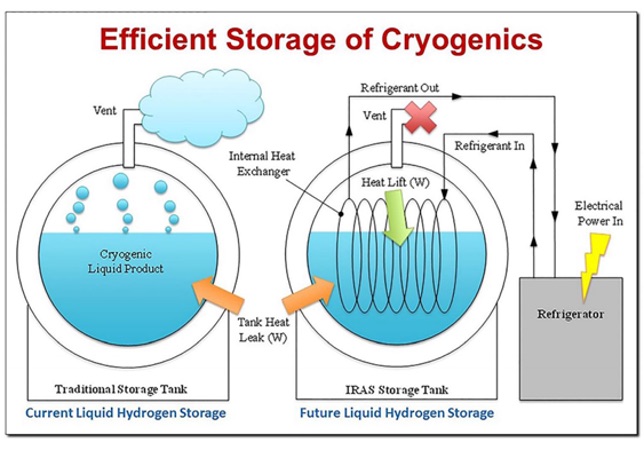
Liquid hydrogen offers a different approach.
Cooling hydrogen to cryogenic temperatures of −253°C allows liquid hydrogen to achieve a much higher energy density than gaseous hydrogen, making storage and transport more compact. This makes it especially attractive for decentralized applications where efficiency and scalability are critical.
Yet, liquid hydrogen has historically faced a major obstacle: boil-off losses.
For decades, hydrogen losses during liquefaction, storage, and transfer have been treated as unavoidable inefficiencies. But as hydrogen infrastructure scales, these losses directly impact economics, operational reliability, and energy availability. In decentralized systems, reducing product loss is essential.
Research led by NASA’s Kennedy Space Center, in collaboration with the National Institute of Standards and Technology, has helped demonstrate the viability of controlled liquid hydrogen storage using active cryogenic refrigeration. Findings from the Ground Operations Demonstration Unit for Liquid Hydrogen (GODU-LH₂) project showed that advanced storage systems can eliminate boil-off and hydrogen venting losses.
Why controlled storage matters
Advanced liquid hydrogen storage systems utilize refrigerated, controlled storage technology to minimize or eliminate boil-off, keeping hydrogen stable and usable for long durations.

This capability changes how hydrogen can function within decentralized energy networks.
Instead of requiring rapid consumption to avoid losses, controlled storage enables hydrogen to serve as a strategic energy reserve — stored efficiently and deployed as needed.
The implications extend across multiple industries. Transit agencies can support zero-emission bus fleets by deploying localized fueling infrastructure. Ports and logistics hubs can deploy scalable hydrogen systems without waiting for large, centralized networks. Industrial facilities can strengthen energy resilience while reducing reliance on diesel backup generation.
Data centers may become one of the most significant opportunities. As AI-driven computing demand accelerates, electricity consumption is rising, and operators are increasingly seeking long-duration backup power solutions that support both reliability and sustainability goals.
Controlled storage of liquid hydrogen can support the development of reliable, flexible energy infrastructure for these emerging applications.
The path forward
Hydrogen will not scale through production advances alone. It will scale through infrastructure that operates efficiently in real-world conditions.
As energy systems continue shifting toward decentralization, storage efficiency will become a defining factor in how hydrogen infrastructure is deployed and scaled. Large hydrogen hubs will continue to play an important role, but decentralized systems may accelerate adoption by enabling faster deployment closer to end users.
The future of clean energy depends on storing renewable power intelligently, efficiently, and at scale. Liquid hydrogen Controlled Storage is destined to become one of the foundational technologies enabling that future.
Greg Gosnell is CEO of GenH2, which focuses on hydrogen infrastructure technology for advanced clean energy. The company’s infrastructure solutions for the liquid hydrogen value chain focus on liquefaction, storage, and transfer to accelerate widescale rollout for advanced clean energy.
GenH2 | genh2.com
Author: Greg Gosnell