




Inverter Topology Issues for Grounded PV Modules


Ever-evolving solar panel technology has led to the development of different types of solar cells. As a result, new types of crystalline cells, such as backside contact solar cells and a number of thin-film technologies, have gained a foothold in the market. Some of these technologies require the inverter to operate in special conditions to maximize the energy produced, or to avoid premature cell degradation. Now, it’s possible to adapt the conversion stage to the conditions required by different types of modules to deliver the optimum system performance.
Thin-film modules
Two construction technologies are available for thin-film modules: one is based on superstrate technology, typically used for Amorphous Silicon or Cadmium Telluride; the other is based on substrate technology, generally used for Copper Indium Selenide (CIS) modules.
The manufacturing process used in the superstrate technology means there’s direct contact between the glass and the TCO (Transparent Conductive Oxide) used to obtain the negative pole. With regard to this module type, recent studies have shown the TCO layer either deteriorates or corrodes after a relatively short period of time in operation. This corrosion is caused by the circulation of leakage currents, which appear when the module is subjected to a negative potential with respect to ground. These currents transport the sodium ions (Na+) present in the glass to the TCO, causing the deterioration.
The circulation of these ions is particularly important in hot and humid conditions. The deterioration of the TCO is irreparable and produces a considerable reduction in the module efficiency.
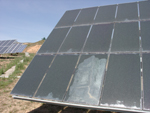 To mitigate the deterioration of the TCO, module manufacturers have adopted various measures, such as improving the module side seal, or increasing the distance between the TCO and the grounding structures (for the frame of the module itself). The first measure prevents the ingress of humidity into the module, while the second measure reduces the circulation of currents that could transport the Na+ ions to the TCO.
In any case, to prevent the circulation of Na+ ions to the TCO, inverters can be used with a grounding kit, to ground the PV array negative pole.
Backside contact modules
The backside contact modules feature solar cells in which the metallization of the positive and negative contacts takes place on the reverse side of the cell. This technology makes it possible to obtain an efficiency of more than 20%, representing a real milestone in the development of solar modules.
Despite the good performance achieved in laboratory conditions, in practice the first high-voltage field-installed arrays have not yet achieved their theoretical efficiency. This drop in performance is the result of the accumulation of charge carriers on the cell surface due to the circulation of small leakage currents through the EVA and the upper glass—a phenomenon known as the polarisation effect. Given the fact cells don’t have contact on the upper surface, these charges cannot be released and, therefore, have an important impact on the overall cell performance. The direction of the leakage current is a decisive factor in the loss of performance. If the cell is subject to a positive potential with respect to ground, then the negative charges remain on the surface, thereby reducing efficiency. However, if the cell has a negative potential with respect to ground, then the effect is reversed and the cell regains its original efficiency.
To avoid the polarisation effect, inverters can be used with a grounding kit, grounding the PV array positive pole. In this way, the module cells operate at a negative potential with respect to ground.
PV array grounding & inverter configuration
PV array grounding can be only done with transformer-based inverters or transformerless inverters connected to a dedicated IT network. A grounding kit for the transformer-based inverters offers the possibility of grounding either the PV array positive or negative pole, in a simple operation. This is a kit that is mounted inside the inverter itself, with no external modification to the array.
To use a grounding kit for modular inverters, they must be configured with the master-slave option. On the other hand, if using a grounding kit with transformerless (TL) inverters, then it’s only possible to connect one inverter per transformer winding.
The following figure shows a typical grounding layout for negative pole grounding on a transformer-based inverter. The PV array grounding is achieved through a protective device (fuse or thermal magnetic breaker, depending on the version), offering protection against fires in the event of a ground fault at the ungrounded pole.
Roberto Gonzalez is the R&D PV solar director for Ingeteam Energy, S.A.
Ingeteam Energy, S.A.
www.ingeteam.com
Author: Roberto Gonzalez
Volume: November/December 2011