



Understanding the Gap Between Monitoring Platforms Vs. Investment-Grade Asset Management


Monitoring platforms tell you how an asset performs. Investment-grade asset management tells you whether the investment is working, and what to do about it when it isn't.
Most renewable energy monitoring platforms have the same basic architecture: telemetry in, thresholds applied, output rendered as a dashboard or an alert. They surface production data, flag deviations, and generate notifications, helping operation teams manage the day-to-day equipment performance. However, monitoring is not sufficient oversight for institutional capital.
Investment-grade oversight of a renewable asset runs across four distinct layers: asset integrity, operational performance and accountability, financial performance, and forward intelligence. A monitoring platform occupies part of the second layer. It tells you how an asset is performing. It does not tell you whether the financial outcome is tracking the model, whether contractual and regulatory obligations are being executed, or what the operating history of a portfolio teaches about the next acquisition. Those questions require something the dashboard was never built to answer.
Four layers of investment-grade oversight
Asset integrity is the foundation. This layer tracks the obligations, agreements, and compliance requirements that define the legal and regulatory envelope within which an asset operates. Interconnection agreements, permit conditions, insurance renewals, NERC obligations, and counterparty commitments all have expiration dates and evidence requirements. Monitoring platforms typically do not track these. For example, when an obligation lapses undetected, the exposure does not show up on a production chart.
Operational performance and accountability are where monitoring platforms concentrate their effort, and where the gap between detection and resolution becomes consequential. Detecting a production anomaly is one thing. Classifying it, routing it to the right party, tracking the work order to closure, and producing a timestamped record of the resolution is another. Institutional investors, including tax equity investors, lenders, and limited partners, do not accept alert logs as evidence. They require a documented chain of custody: issue identified, routed, resolved, and verified. That chain does not emerge from dashboards alone.
Financial performance is a layer that monitoring platforms largely ignore. Comparisons of budget versus actual, production versus hedge obligation, and revenue versus financial model all require a system that can hold the model, receive actuals, surface variances, and record explanations. Without that capability, the financial narrative an asset manager presents in a quarterly review is assembled manually from spreadsheets and system exports and can rarely be reconstructed on demand when a lender or LP requests follow-up.
Forward intelligence is what makes a portfolio more than a collection of individual assets. Operating history that includes failure patterns, degradation curves, O&M cost distributions, and contract performance by counterparty is the raw material for better underwriting, better diligence, and better capital deployment. That intelligence is only accessible when the data from every asset has been collected and structured in a consistent, query form. Most organizations never get there because their operational data lives in monitoring dashboards, email threads, and spreadsheets that were never designed for aggregation.
Why the gap persists
The persistence of the problem is structural. A monitoring platform can be extended to track more data types. But it is much harder to do because it requires enforcing accountability across a distributed operating team, producing audit-grade records across all four oversight layers, and feeding a financial model with the operational data that explains performance variances.
The deeper issue is that closing the loop requires human accountability, not just data collection. When a deviation is detected and routed to an O&M contractor, someone must confirm receipt, track the work to completion, and verify that the resolution meets the standard. A platform can scaffold that workflow, but executing it requires organizational discipline. Platforms that credibly cover all four oversight layers come from teams that have operated renewable assets themselves.
What investment-grade asset management software provides
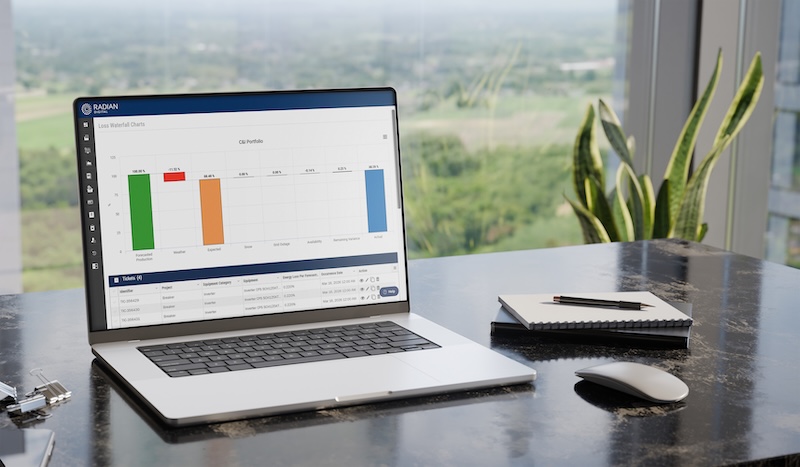
Investment-grade asset management software is distinguished by its scope: it is built to address all four oversight layers, not just operational performance. On the asset integrity side, it tracks every obligation with a due date, surfaces items before they become exceptions, and routes them through a documented resolution workflow. The output can be used to demonstrate compliance.
On the operational side, it closes the loop from detection to resolution. An anomaly is not just flagged; it is classified, assigned, tracked, and verified, with a record that an auditor can read. On the financial side, it houses the model, receives actuals, and produces variance explanations that withstand scrutiny. A quarterly investor report becomes a document backed by a defensible record, rather than a narrative assembled the week before.
On the forward intelligence side, it structures operating history in a form that compounds over time. Fleet-wide degradation data informs acquisition underwriting. Contractor performance data shapes O&M procurement decisions. Contract structure learnings inform the next development cycle. This is not possible if the data sits in monitoring dashboards that were never designed to aggregate across assets.
A simple question exposes the difference. Take any operational issue from the last quarter and trace it: when was it detected, how was it classified, who received it, when was it resolved, and how was the resolution verified? If the trail goes cold at the alert, the organization is running on monitoring. If it runs all the way to a timestamped, auditable record, and that record is one of thousands produced systematically across the portfolio, then the organization has investment-grade asset management in place.
The new standard for institutional capital
The four-layer model reflects what sophisticated investors have always required and what was previously delivered, imperfectly, through a combination of internal teams, external advisors, and manual reporting. Investment-grade asset management software makes delivery systematic, consistent, and scalable.
 Eric Baller is COO of Radian Digital, Radian Generation's asset management platform built by asset managers to help renewable energy investors meet their financial and operational commitments.
Radian Digital | radiangen.com
Author: Eric Baller