




Volt Carbon and C4V Achieve New Milestone in Proprietary BMLMP Lithium Metal Battery Program


Volt Carbon Technologies Inc. (TSXV: VCT) (OTCQB: TORVF) (BE: WNF) ("VCT", "Volt" or "Volt Carbon") and Charge CCCV LLC ("C4V") are pleased to provide an update on their strategic relationship, originally announced on November 17, 2023 and subsequently expanded through collaborative development activities and the Memorandum of Understanding announced on March 24, 2025.
Building upon the successful battery and graphite validation results announced on February 4, 2025, a second round of lithium metal coin cell testing utilizing Volt Carbon's proprietary electrolyte and C4V's proprietary Bio-Mineralized Lithium Mixed Metals Phosphate ("BMLMP") cathode technology has surpassed 850 charge-discharge cycles, representing an approximately 30% improvement in demonstrated cycle life over the previously announced results exceeding 650 cycles.
Dr. Shailesh Upreti, Founder and CEO of Charge CCCV LLC, stated: "Our relationship with Volt Carbon has continued to advance since the initial strategic agreement announced in 2023. The latest lithium metal battery results demonstrate continued progress with Volt Carbon's electrolyte technology and our proprietary BMLMP cathode platform. At the same time, ongoing graphite qualification activities and the upcoming evaluation of Volt Carbon's low-temperature electrolyte represent important next steps in our shared objective of advancing innovative battery technologies and strengthening North American battery supply chains."
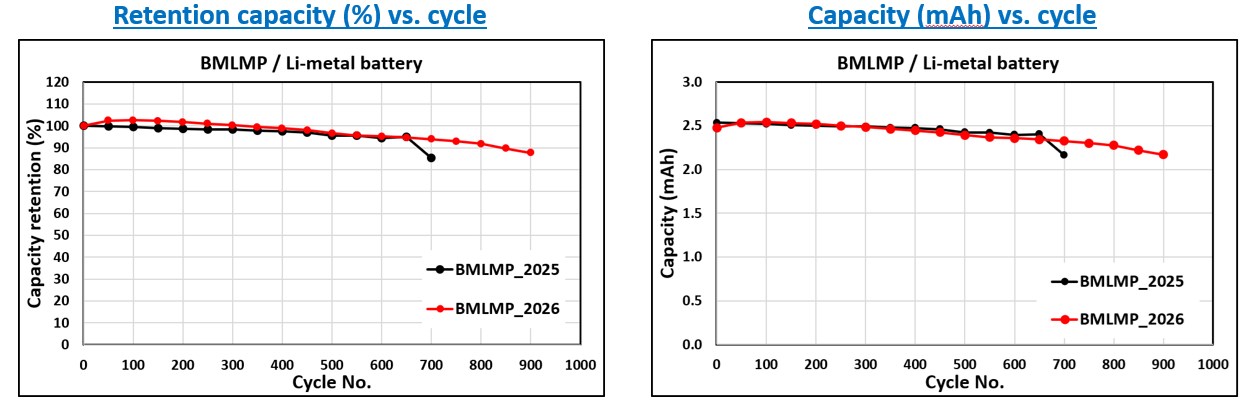
Fig. 1. BMLMP lithium metal coin cell utilizing Solid UltraBattery electrolyte; C/4 charge rate and C/2 discharge rate, demonstrating stable cycling performance beyond 850 cycles. Note: Test results have not been independently verified.
(https://images.newsfilecorp.com/files/9904/301670_1a4f099664e10a9e_001full.jpg)
In parallel with the battery program, Volt Carbon is preparing additional shipments of its high-crystallinity graphite material for continued qualification under C4V's Green Anode initiative. The program is intended to evaluate Volt Carbon's dry-separated graphite as part of a secure and sustainable North American battery materials supply chain. In addition, Volt Carbon will participate in C4V's Digital DNA (DDNA) program, leveraging C4V's rapid data access and performance benchmarking platform to generate comprehensive electrochemical performance data, accelerate material validation, and provide pathway for commercialization.
Volt Carbon is also preparing a batch of its proprietary low-temperature electrolyte for shipment to C4V for the next phase of lithium metal battery testing utilizing C4V's proprietary BMLMP cathode to take place in Binghamton.
The next phase of development is expected to include low-temperature battery testing and progression toward pouch cell validation, consistent with the objectives outlined in the companies' March 2025 Memorandum of Understanding. The collaborative development program is focused on advancing next-generation lithium metal batteries through continued cycle-life validation, low-temperature performance testing, and larger-format cell development.
The collaboration between Volt Carbon and C4V now encompasses two strategic development pathways:
-
Advancement of a North American battery materials supply chain through qualification of Volt Carbon's graphite within C4V's Green Anode platform, coupled with accelerated material evaluation and performance benchmarking through C4V's Digital DNA (DDNA) program.
-
Development of next-generation low-temperature lithium metal batteries utilizing Volt Carbon electrolyte technologies and C4V's proprietary BMLMP cathode chemistry, consistent with the development objectives previously established under the companies' March 2025 MOU, including battery systems approaching 300 Wh/kg.
V-Bond Lee, President and CEO stated: "Exceeding 850 cycles marks another important milestone in our collaboration with C4V. We are now advancing toward pouch cell testing using C4V's proprietary BMLMP cathode technology. Moving from coin cells to larger-format cells brings us closer to evaluating the technology under practical operating conditions where cycle life, energy density, safety, and low-temperature performance are critical."
Volt Carbon Technologies | www.voltcarbontech.com