




UL Research Institutes Releases New Evidence-Based Report Examining Electric Vehicle Fires, Including Tactical Considerations for Firefighters


UL Research Institutes' Fire Safety Research Institute released a new report, "Full-Scale Electric Vehicle Fire Experiments and Recommendations for Fire Incident Response," helping close the knowledge gaps around EV fires and suppression tactics.
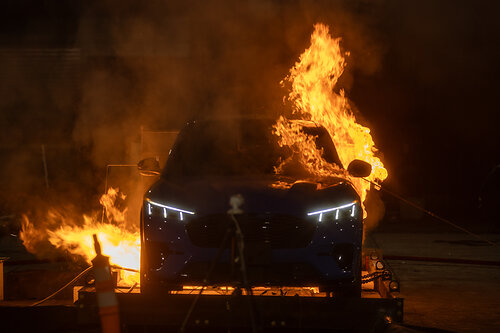
ULRI conducted full-scale burns of 18 vehicles to examine the differences and similarities between gas vehicles and EVs. This included nine free burns, or experiments conducted without fire suppression. Following the free-burn experiments, the research team burned nine additional EVs to evaluate common suppression tactics, including water only, EV fire blankets, and water with an added suppression agent. Researchers fully charged all EVs, initiated the battery fires with a propane burner, and then allowed the fires to grow for six minutes before beginning suppression. The six-minute delay replicates standard fire response time in North America.
"Lithium-ion battery-powered devices and EVs are already changing how we move, communicate, and enjoy our leisure time," said Adam Barowy, principal research engineer for the Fire Safety Research Institute. "This research moves us closer to understanding how batteries change the fire environment and helps equip first responders to adequately address fires involving this new source of fuel. Our findings demonstrate that when it comes to EVs, first responders can effectively manage the hazard with familiar tools and tactics."
Key findings from the report include:
- Expect similar fire behavior and hazards from EVs and gas vehicles
Data from free-burn experiments concluded that EV and ICEV fires are similar in fire growth rate, peak fire size, and fire duration. On average, EVs released more total energy, attributed to greater vehicle mass.
- Use water to control EV fires and reduce exposure
For most EV fire incidents, water can be used to suppress the cabin fire, limit exposures, and control flaming from thermal runaway while the battery burns itself out. None of the tested suppression techniques halted thermal runaway once it started, and an added suppression agent was no more effective than water. Direct battery extinguishment or cooling are precluded by vehicle construction and are not recommended.
- Use EV fire blankets with caution
While effective for controlling vehicle flaming, researchers observed that an explosion hazard can occur when flammable gases accumulate underneath a deployed EV fire blanket or those gases accumulate in a confined operating environment. If used, blankets should not be repositioned, and it is recommended that fire blankets not be used indoors or in confined spaces due to deflagration risk. They should not be considered a replacement for water-based suppression.
- Remain in full PPE and SCBA throughout the incident
Full personal protective equipment and self-contained breathing apparatus are required throughout the incident, including overhaul, due to persistent toxic exposures and the risk of reignition. Much of the exposure hazard is driven by the passenger compartment fire, but elevated concentrations of metals and particulate fluoride associated with the battery fires were found in smoke, suppression runoff water, and were found to contaminate firefighting turnout gear.
The full report provides detailed considerations for firefighters including size-up, exposure hazards, suppression, and overhaul. The team also developed an EV Fire Tactical Decision Aid, a step-by-step tool designed to analyze, develop, and improve fireground decision-making. The findings and tactical considerations will inform the development of an EV firefighting course in the Fire Safety Academy, scheduled for release later this year. Full air, surface, water, and PPE decontamination results are undergoing peer review or final analysis and will be published over the next year.
ULRI is focused on understanding how lithium-ion batteries — whether in e-mobility devices or electric vehicles — change the fire environment so that first and second responders can respond safely and mitigate the hazard, and the public can minimize hazards arising from personal use.
Fire Safety Research Institute | fsri.org
UL Research Institutes | https://ul.org/