




Thinner Grains Help Sodium-Ion Batteries Resist Hidden Cracks


Layered oxide cathodes are among the most promising materials for sodium-ion batteries (SIBs), but their internal grains can crack as sodium ions repeatedly move in and out during cycling. A new study shows that this failure can be reduced by reshaping the crystal grains rather than only changing chemical composition. By tailoring the c-axis dimension of P2-Na0.75Ni0.25Mn0.75O2, the researchers created thinner prism-like grains that release lattice strain more efficiently, reduce stress concentration, and suppress intragranular cracking. The optimized cathode retained 96.7% of its capacity after 300 cycles at 5 C, pointing to a practical design route for more durable sodium-ion battery materials.
Sodium-ion batteries are attracting growing interest for large-scale energy storage because sodium is abundant, widely distributed, and compatible with low-cost battery chemistry. Layered transition-metal oxides offer high capacity and good scalability as positive electrode materials, but their mechanical stability remains a major barrier. During sodium-ion intercalation and deintercalation, the crystal lattice expands and contracts unevenly, especially along the c-axis. This non-uniform lattice strain can concentrate stress inside the grains, causing cracks, exposing fresh surfaces to the electrolyte, and accelerating side reactions and capacity loss. Based on these challenges, there is a need to develop microstructure-level strategies that can relieve internal stress before it damages the cathode.
A team led by Wuhan University of Technology, with collaborators from Xi’an Jiaotong University, published (DOI: 10.1016/j.esen.2026.100070) the study online on May 20, 2026, in eScience Energy. The researchers investigated how c-axis dimension tailoring affects stress evolution in layered P2-type Na0.75Ni0.25Mn0.75O2 cathodes, showing that thinner grains can reduce strain build-up, improve stress dissipation, prevent internal cracking, and extend sodium-ion battery cycling stability.
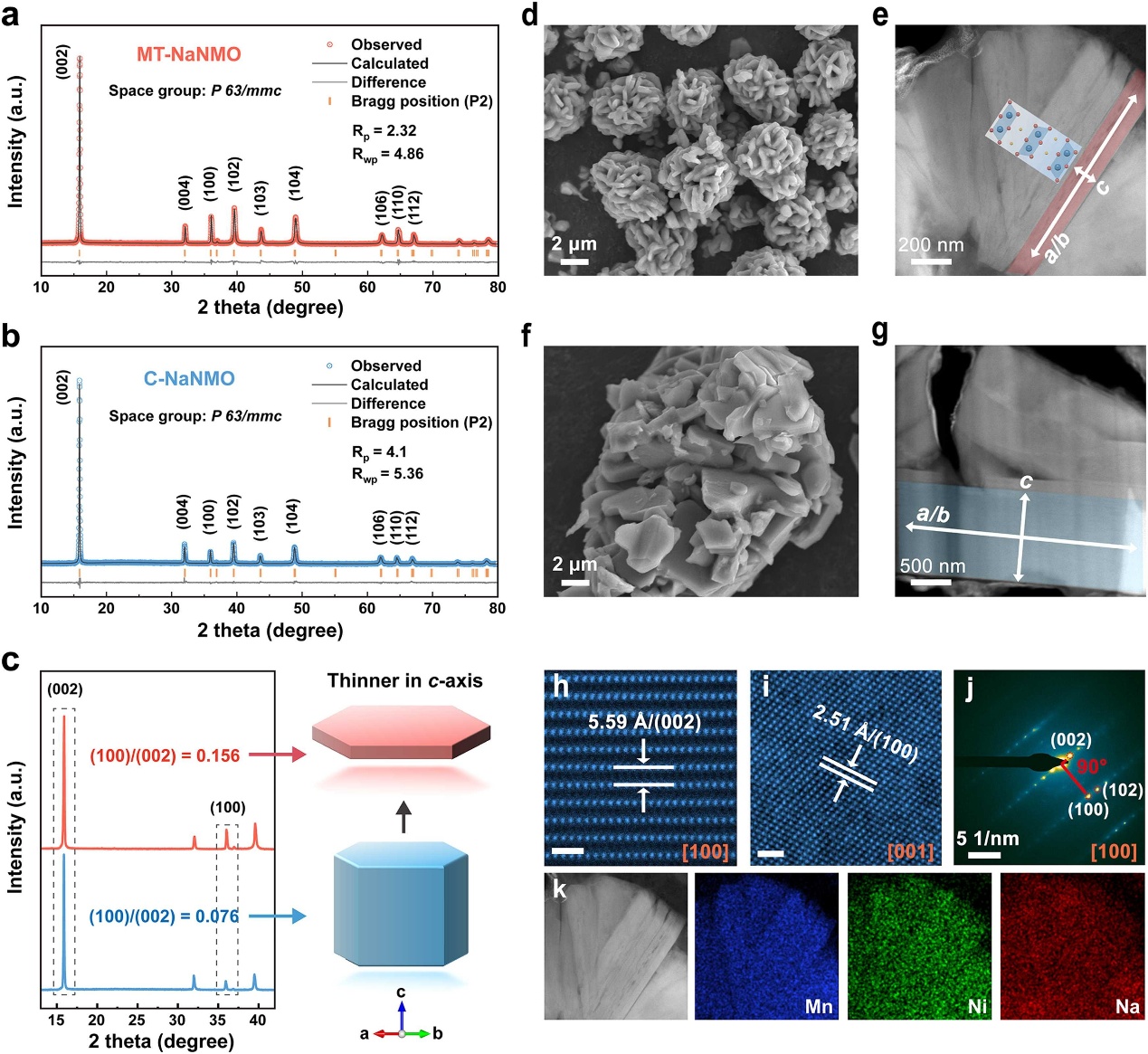
The team prepared morphology-tailored NaNMO (MT-NaNMO) and comparison NaNMO (C-NaNMO) samples with the same chemical composition, allowing the effect of grain geometry to be isolated. X-ray diffraction (XRD), scanning electron microscopy (SEM), and electron microscopy analyses confirmed that both materials kept the P2 layered structure, but MT-NaNMO formed thinner prism-like primary grains of about 200 nm along the c-axis, compared with about 800 nm in C-NaNMO. In situ XRD showed that both samples had similar unit-cell-level lattice changes during charging and discharging, indicating that the key difference lay in how strain accumulated across the grain. High-resolution transmission electron microscopy (HRTEM) combined with geometric phase analysis (GPA) revealed stable lattice fringes and uniform strain fields in MT-NaNMO, while C-NaNMO showed lattice distortion and localized strain. Finite element analysis (FEA) further confirmed that reducing the c-axis dimension produced a more even stress distribution. Electrochemical impedance spectroscopy (EIS) and cycling tests showed faster sodium-ion transport, lower resistance, and much stronger long-term stability in MT-NaNMO.
The authors said the study offers a way to think about battery failure before visible damage appears. They said sodium-ion storage creates a repeated “breathing” motion in layered oxides, and thick grains allow this strain to build up until cracks form. By shortening the most vulnerable direction, the material can release stress earlier and more evenly. They said this principle could help guide cathode design beyond composition tuning, giving researchers a clearer mechanical strategy for building sodium-ion batteries that remain stable over prolonged cycling.
The findings have practical implications for next-generation energy storage. Simply reducing overall particle size can improve stress release, but it may also increase surface side reactions and reduce tap density. In contrast, c-axis tailoring focuses on the direction most closely linked to tensile stress and intragranular cracking. The optimized MT-NaNMO cathode also performed well in a full cell paired with a hard carbon (HC) negative electrode, achieving an energy density of about 218.3 Wh kg−1 and retaining 92.6% capacity after 300 cycles at 2 C. This directional microstructure strategy could support more reliable, lower-cost sodium-ion batteries for renewable-energy storage and grid-scale applications.
Wuhan University of Technology | https://english.whut.edu.cn/