




ESS Introduces Bridge, a Modular Sodium-Ion Battery Energy Storage System for Grid-Scale, Data Center, and Commercial Applications


ESS Tech, Inc. (NYSE: GWH) (“ESS” or the “company”), a leading provider of non-lithium energy storage solutions, announced the launch of the ESS Bridge, a modular sodium-ion battery energy storage system (BESS) designed for utilities, AI-driven data centers, critical infrastructure operators, and commercial and industrial customers seeking superior alternatives to conventional lithium-ion technologies.
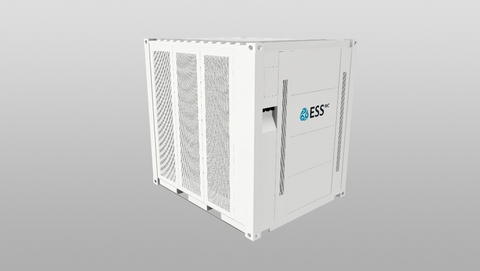
The introduction of Bridge marks a significant milestone in ESS's strategy to become a leading provider of U.S.-made, non-lithium energy storage solutions spanning short-, medium-, and long-duration applications.
The Bridge name reflects the platform’s role in connecting energy generation and consumption while bridging the gap between today's energy needs and a more secure and resilient energy future.
The release follows ESS's recent news that it has generated more than $1 billion in early-stage customer opportunities since announcing its sodium-ion market entry, reflecting growing demand for safer energy storage technologies that can meet the power needs of AI data centers and other critical infrastructure.
"Bridge is how we meet the demand we're already seeing," said Drew Buckley, CEO of ESS. "AI workloads are reshaping what data centers need from energy storage, and sodium-ion handles those power needs more effectively than conventional technologies. Bridge is built to deliver that, which is why we've generated nearly a billion dollars in early-stage opportunity since entering sodium-ion."
Bridge is a 1.2 MWh building-block AC battery system that combines advanced sodium-ion technology with ESS's expertise in system integration, controls, energy management, and project execution. With the solution, ESS provides complete system integration, including battery cells, modules, racking, power conversion, cabling, and battery management system (BMS) hardware and software in a 10-foot container. ESS is also providing an energy management system (EMS) to enable plant-level monitoring, optimization, and control.
The plug-and-play unit simplifies logistics, can be installed with a heavy-duty forklift and can operate in myriad environments with simple air cooling. The modular blocks are stackable, delivering up to 4.8 MWh of storage capacity in the same footprint as a traditional 20-foot battery container, maximizing site utilization. The building block system scales easily to support both commercial and large, utility-scale applications.
Unlike conventional lithium-ion systems, Bridge is designed to eliminate the risk of fire from thermal runaway and requires no complex HVAC or liquid cooling systems, reducing operational complexity, maintenance requirements, and total cost of ownership. It is capable of a wide range of charge and discharge profiles, from 1 to 16 hours or more depending on configuration.
Engineered for demanding environments, Bridge is designed to reliably provide power in environments from -40° C to 50° C with a 20-year operating design life, helping owners avoid costly battery replacement and risky augmentation cycles.
Built around abundant, widely available materials, Bridge is designed to leverage an emerging alternative supply chain to conventional lithium-ion batteries, reducing exposure to constrained critical minerals and geopolitical sourcing risks. The solution supports the development of a future domestic energy storage supply chain while helping customers manage exposure to Foreign Entities of Concern (FEOC).
"Today’s battery asset owners are looking for solutions that improve upon the conventional model," said Randall Selesky, Chief Commercial Officer, ESS. "They want systems that improve safety, simplify operations, provide flexibility and support long-term energy security objectives. Bridge is designed to deliver those benefits in a single platform."
ESS Tech | https://essinc.com/