




The 50 States of Power Decarbonization: States Pull Back on Clean Energy Commitments While Governors Step In to Address Large Load Additions in Q2 2026


The NC Clean Energy Technology Center (NCCETC) released its Q2 2026 edition of the 50 States of Power Decarbonization. The quarterly series provides updates on state and utility actions pertaining to clean energy targets, emission reduction targets and carbon policies, generation planning and procurement rules, large load customer treatment, integrated resource plans, and electric generation capacity changes (RFPs, CPCN requests, power plant retirements, etc.).
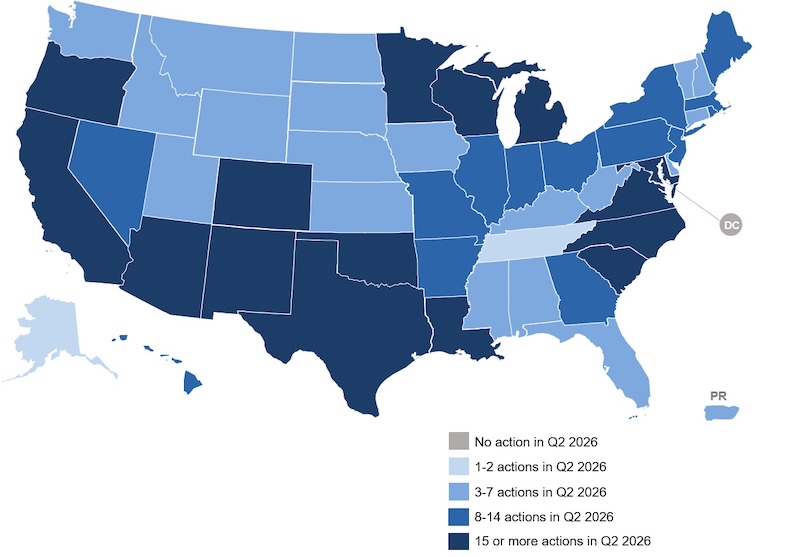
The Q2 2026 report finds that all 50 states, as well as Puerto Rico, took a total of 564 actions related to electric power decarbonization and resource planning during the quarter (see figure below), in addition to approximately 650 introduced bills considered during the quarter that had not yet passed a legislative chamber.
The most active states this quarter were California, Louisiana, Colorado, and Virginia, followed by South Carolina, Maryland, and Wisconsin. Among integrated resource plans recently filed or under review by regulators in Q2 2026, planned capacity additions totaled 77,810 for natural gas, 72,193 for solar, 43,017 for storage, 12,615 for nuclear, and 12,327 MW for wind, while planned coal retirements totaled 26,752 MW.
Q2 2026 Action on Power Decarbonization and Resource Planning
The report discusses three trends in power decarbonization actions taken in Q2 2026: (1) state lawmakers and regulators pulling back on clean energy policies; (2) governors taking steps to address large load additions; and (3) states requiring large load customers to contribute to customer programs, including those supporting low-income customers and energy efficiency efforts.
“Data centers and other large load customers continue to be at the forefront of policymakers’ minds. This quarter saw heavy involvement from state governors, with five governors signing executive orders or taking other major actions relating to large load customers,” observed Emily Apadula, Senior Policy Analyst at NCCETC. “Topics ranged from creating studies, development frameworks, and creating advisory councils, with many governors calling out economic development and ratepayer protection as key factors in their executive orders.”
The report notes the top five policy developments of Q2 2026 were:
- New York legislators adjusting and delaying the state’s interim emissions target;
- Georgia regulators approving Georgia Power’s Bring Your Own New Clean Energy (BYONCE)
program; - Pennsylvania regulators adopting a statewide model large load tariff;
- New Jersey lawmakers lifting a de facto moratorium on nuclear energy; and
- Evergy updating its integrated resource plans in Kansas and Missouri and delaying coal retirements in response to large load customer demand projections.
“Policymakers in a growing number of states are also reconsidering their clean energy goals and emission reduction targets,” noted Brian Lips, Senior Project Manager at NCCETC. “The motivations vary from state to state, but include concerns over affordability, shifting federal policies and incentives, and rapidly increasing demand from large load customers.”
View the 50 States of Power Decarbonization Q2 2026 Quarterly Report Executive Summary
View and Purchase the 50 States of Grid Modernization Q2 2026 Quarterly Report
NC Clean Energy Technology Center | https://nccleantech.ncsu.edu/