




Overcoming Challenges: Technology & concentrated solar power


The relatively new technology known as concentrated solar power (CSP) holds much promise for countries with plenty of sunshine and clear skies. CSP plants produce electric power by converting the sun’s energy into high-temperature heat, using a configuration of lenses or mirrors. Unlike photovoltaic (PV) systems, which use photon energy from the sun, CSP systems uses solar energy as a thermal heat source. Their output nicely matches the shifting daily demands for electricity, particularly in places where air-conditioning systems are widespread. When backed up by a thermal storage capability, CSP offers electricity that can be dispatched when required, enabling it to be used 24 hours per day.
There are four main technologies in use today that collectively make up CSP:
1. Power tower;
2. Sterling engine;
3. Solar trough; and
4. Linear Fresnel reflector.
Solar troughs collect the sun’s energy using long, parabolic mirror collectors (whereas linear Fresnel reflectors use long, thin segments of mirrors). Solar trough fields consist of a large array of these modular collectors and, to date, they dominate in numbers. There are far more of these power plants constructed than any other technology, at least throughout the United States and in Spain. However, the forecasts indicate that power tower is expected to grow at a faster rate than the other technologies over the next three or four years. Power tower makes use of a heat-transfer fluid (either water/steam or molten nitrates salt), which is heated in a receiver to generate steam, and then is used in a conventional turbine generator to produce electricity.
Ideally, within a decade, CSP will be able to compete with coal plants that emit high levels of CO2. Moreover, the sunniest regions (such as North Africa) might be able to export surplus solar electricity to neighboring regions (such as Europe), where demand for electricity from renewable sources is strong. Ongoing research in CSP is allowing newer innovations, such as the sterling engine, which can replace the parabolic dish in some of these plants (dish Stirling tends to be more suited to off-grid or highly distributed power generation).
Nevertheless, the cost of entry for CSP is still prohibitive when compared to transitional electricity generating methods. And, this holds true even compared to more mature renewable technologies, such as wind power. This is due to the installation, operating, and maintenance costs of running CSP plants. Pricey generating costs, or the Levelized Cost of Energy (LCOE), could be considered the primary challenge concentrated solar plants must overcome.
Developmental difficulties
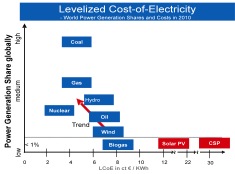 Aside from LCOE, other challenges exist as well, and can stand in the way of a potential CSP project. Economics, technology development, supply, construction, operation, and sustainability should all be considered as follows…
1. Economics. Understanding the economics of solar power is fundamental to a successful project. Considering the cost drivers of solar power in comparison to the cost distribution between collector, receiver, turbine, and balance of plant (BoP) is key. Planning a successful solar strategy requires a detailed understanding of these expenses and revenue drivers, and includes the dispatch-ability of CSP power. Often time, price will be the primary barrier of a CSP project.
2. Technology development. From the initial design to the final engineering, technology development should be managed on a broad range of indicators—and not just based on costs alone. Risk can be assumed, but must be rigorously managed for success. Winners in this sector will be the project owners who protect their technology, handle intellectual property (IP) with a developed IP strategy, and work well with third parties. Capturing the requirements and joining the development process together from beginning through to verification and validation is critical; otherwise, a CSP project likely won’t deliver on its promises.
3. Supply. Running a robust tender process is vital for all solar projects, and especially for concentrated solar ones. Assembly and supply partners should be considered, herein. The process should be designed to manage risk by assessing tenders on a range of factors. Long-term demand, for instance, is an element within this process. Project pipeline and forecast volume projections can, and should, be used to help support drive, and a fact-based negotiation strategy is imperative. Additional factors include: the type of relationships desired for a project (whether it be a partner or someone at arm’s length); ensuring all non-disclosure agreements (NDAs) are in place, and are enforceable; identifying higher risk items that may drive dual sourcing decisions; and making sure engineering teams have commercial design skills in-house, or can partner to get them.
4. Construction. Construction projects have a number of understood risks, but there are a few that are critical for driving down the risks and costs in solar energy projects. Renewable plant construction is made complicated by the size of the “volume” components, so it’s important to develop a cost-effective assembly strategy and to optimize construction sequencing. Heliostat assembly is often required at the site, for example, along with the related facilities that are necessary. In the case of CSP heliostats, assembly is also made difficult in the field due to the physical size and high-tolerance requirements.
5. Operation. Integrating the operation and maintenance (O&M) team into the design process as early as possible is vital to a successful project. This helps with any challenges related to the maintenance procedures, the project’s health and safety, and the life testing of all critical parts. Other considerations include field calibration and optimizing field spares.
6. Sustainability. As it is, CSP faces challenges in technology and capacity road blocks, including never-before-seen high-value, high-volume commodities. Therefore, growing the capability and competence base—in terms of manufacturing and technology capability, as well as human capital—is fundamental in building CSP into a commercially sustainable industry. Over time, providing a development pathway from subcontracting/manufacturing provision, through to research and development (R&D), and established suppliers, can provide high, value-added solutions. The implementation of knowledge-transfer processes and an educational system will help aid sector maturity.
Coming of age
Concentrated solar power holds great potential for the future. Its scale can provide volume leverage to bring prices down. Plus, with new, molten salt storage technologies, it’s now possible to generate power when the sun goes down—technically breaking one of the previous laws of solar power. However, its ascent is not without challenges, particularly when it comes to costs.
The good news is that the emerging existence CSP plants around the world suggest that these challenges can be successfully overcome. The technical advances being made today are allowing larger plants to be constructed. Plus, borrowing tips from other sectors, (such as using the approaches and tools developed for high-volume production in the automotive sector) is also driving progress in many areas of CSP, especially in professional strategic sourcing, supplier development, and supply chain integration. The future of CSP remains promising.
Barinder Lalria is a renewable energy expert at PA Consulting Group.
PA Consulting Group
www.paconsulting.com
Author: Barinder Lalria
Volume: May/June 2013