



Turning Campus Food & Yard Waste into Clean Energy


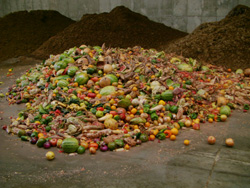 Remember back to your college days, and thoughts might wonder to those seemingly endless essays, final exams, and missed letter grades—with a few parties in between. Along the way, there were likely some leftover bags of potato chips, forgotten granola bars, and half-consumed cups of coffee left on campus. At one US university, those “leftovers” are generating much-needed energy in the name of “greener” living.
The University of Wisconsin – Oshkosh has adopted anaerobic digestion technology to help meet its campus’ sustainability goals. This process melds with the entire line of renewable energy projects already implemented by the University, which now includes solar, geothermal, and biogas technologies. The school’s ultimate goal is to reduce dependence on fossil fuels, and to provide educational learning opportunities for current and future students.
Anaerobic digestion
Since the materials immediately available for digestion at the University were high solids materials (>25% total solids), a dry fermentation digestion system was the most logical technology choice to process these materials. Dry fermentation uses waste streams with higher solids contents that typically cannot be pumped very easily, and remain static during digestion. This dry fermentation facility, Biodigester I, is one of three anaerobic digestion installations the school will be installing over the next few years through a partnership developed with a biogas plant technology provider.
The University completed construction and installation of Biodigester I, the first dry fermentation digestion system in the Americas, during early August 2011—and start-up began in early October 2011. The plant is located directly on campus, accepting up to 8,000 tons of waste per year.
Initial feedstock for Biodigester I isn’t just from the school, but includes separated food waste from campus, pre-consumer food waste from local grocery stores, City of Oshkosh yard trimmings, and local farm bedding materials. Material is delivered into an enclosed mixing area, which allows odorous emissions to be captured and filtered via a biofiltration unit to eliminate smells prior to exhausting to the atmosphere. Each week, one of the four fermenters (concrete garage units that are 70' long x 23' wide x 16.7' high) is opened to remove previously digested material, and to reload it with fresh material. Material is moved into the concrete garages via a front-end loader and stacked into a pile. Once the garage is filled, the doors are sealed for 28 days.
During this time, a liquid percolate solution is applied to the pile to help facilitate the anaerobic degradation process in which biogas containing methane is produced. Anaerobic digestion is the breakdown of organic materials in the absence of oxygen to produce biogas. Biogas is comprised primarily of methane and carbon dioxide, and is an energy-rich fuel source comparable to natural gas. Biogas is collected and sent to a combined heat and power (CHP) unit that burns the gas to produce electricity and heat. The installed capacity of the CHP is 370 kWel, which is sized slightly larger than the expected output of the digestion process alone—since the University has partnered with the neighboring wastewater treatment plant (WWTP) to obtain biogas from the degradation of wastewater sludge.
Working in collaboration
This biogas will be piped over from April to October, and mixed with the biogas produced on site. The collaboration helps utilize the energy potential of otherwise flared biogas to produce more electricity for the grid. Biodigester I will provide up to 10% of the campus electricity and heating needs, or enough electricity to power up to 210 homes. The average American home uses 11,040 kWh per year.
The University has created multiple partnerships to assist in making this project a success. This includes receiving grant funding from the US Treasury Section 1603 (~$1.1 million), the US Department of Energy ($500,000), and the State of Wisconsin’s Focus on Energy Program ($232,587). There was also a large amount of financial support that was generated by the University of Wisconsin – Oshkosh Foundation, which owns Biodigester I, and is supportive of all biodigester efforts at the University.
In addition, the anaerobic digestion installation has prompted the installation of a state-of-the-art laboratory and research facility on-campus, the University of Wisconsin – Oshkosh Environmental Research and Innovation Center (UWO ERIC), to provide testing, research, and development in the areas of water quality and waste management. This combination of research and educational training centers for real-world application was inspired by the European concept of teaching academies, promoting the University of Wisconsin – Oshkosh education system and the renewable energy market.
The project as a whole reduces greenhouse gas emissions by preventing methane emissions from organics that are placed in landfills, an equivalent of 9,500 tons of carbon dioxide, in addition to preventing 2,100 tons of carbon emissions from non-renewable energy sources. The University has pioneered an approach to managing energy in a clean, renewable way, while providing a working demonstration for the educational benefit of future generations.
Bioferm Energy Systems
www.biofermenergy.com
Author: Steven Sell
Volume: July/August 2012