




The Roads Less Traveled: Keeping up with the growing wind industry


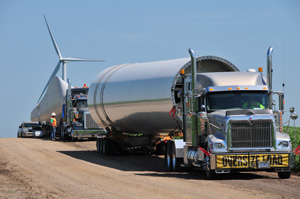 The wind industry has come a long way from its early days of a windmill or two sited on a patch of farmland, or even from the ability of turbines to power a small neighborhood or a few dozen homes. The wind turbines seen today are highly efficient, and the result of decades of research and development. A typical unit alone can generate enough electricity to power over 500 homes, if not more. The larger units, which are becoming more commonplace on wind farms, can generate between two to three megawatts (MW) of power.
According to the American Wind Energy Association (AWEA), the US wind industry now totals 46,919 MW of cumulative wind capacity, as per 2011. With over 8,300 MW currently under construction, wind power capacity in the Unites States represents more than 20% of the world’s installed wind power (www.awea.org). Yet, with over 100 separate wind power projects being built at over 31 states, all of those towers, blades, nacelles, and structures that make up each turbine and create a wind farm have to come from somewhere.
With up to 200 or so separate towers on one farm, the logistics of transportation becomes an imminent issue once a wind power project has gained approval for construction. Getting from point A to point B isn’t always an easy task. For example, for a 100 MW wind power project, a site might require as many as 600 truck and trailer loads—not to mention the rail cars and vessels that are sometimes necessary—just to meet the transportation requirements needed to ensure all the needed wind tower components make it to their site destination.
Transportation & logistics
Regardless of the number of vehicles or vessels required, road safety and logistics come into play when it comes to transporting wind tower components. This is where engineering and route studies are critical to the safety of the cargo. Though a direct approach may seem like the fastest, easiest, and most cost-effective way to go, it’s not uncommon to travel up to 50% or more away from a destination in order to ensure the safest route for the turbine components. In fact, it’s quite rare that a site provides for easy access. Most wind farms are located away from the urban rush in uncharted areas, at least in terms of roadways. Terrain can be rocky, uneven, forested and, often times, obstructed.
To avoid as many major infrastructure risk points as possible, the safest route is coordinated through various city and state jurisdictions. However, regulations vary greatly between each state, so coordination often proves to be quite challenging. Once safely at a wind farm site, further assistance is usually required (such as an assist vehicle hook up to the trailer) to reach the very final destination. For instance, a completely different tractor and trailer might be needed to get to an actual turbine pad, depending on the road compaction or grade conditions.
Because the state permitting process isn’t streamlined, getting large wind components to their site destination is one of the biggest challenges in terms of transportation and logistics. Another growing concern and difficulty is the current trend toward growing turbines. Over the last several years, most OEM’s have moved from employing 1 MW or 1.5 MW machines at their wind farm to 2 MW or 3 MW machines. This is in order to capture lower wind speed areas, and has resulted in turbines that are heavier, towers that are taller, and blades that are longer.
The greater the turbine capability, the greater the power generated. This makes sense, however, the larger components are putting greater pressure on the industry’s equipment availability to transport such sizes. And, not only do these larger components put pressure on the current equipment availability, but they also limit the routes that are approved by various states to travel. The limitations on transport routes can cause extreme variability and out-of-route miles. In turn, this can lead to increased transport costs and longer transport time—something any business or industry is always trying to curtail.
Charting the course
To keep up with the growing turbine sizes and various state jurisdictions for transportation permitting, it’s important to pre-plan each individual project. These project plans have to be significantly reviewed and vetted to make sure the best game plan is executed from the beginning when it comes to project safety, project budgeting, an on-time delivery. After safe delivery, it’s worth doing a post-project review to compare the outcome with previously established standards and metrics. This helps determine whether these metrics were met, if the best solutions were put in place, and how to improve in the future if possible.
When planning for a potential wind farm, the advice is simple: pay attention to the logistics. Get upstream in the process to either avoid or be prepared for any potential choke points in the process. This is particularly important in relation to the larger, megawatt turbines, and issues such as site compaction, turning radiuses, and overhead obstructions.
With an understanding of the transportation and logistics involved when it comes to building a wind farm, developers can make the best decisions and build a more solid and realistic delivery schedule.
Alan Redding is the Director of Sales and Business Development at ATS Wind Energy Services.
ATS Wind Energy Services (a division of Anderson Trucking Service)
www.atswes.com
Author: Alan Redding
Volume: March/April 2012