




Developing Utility-scale Wind Projects: In harmony with the environment


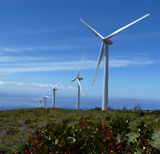 Wind energy is clean and renewable, and it helps offset two of the most damaging impacts of conventional electricity generation—air pollution and natural resource depletion. However, like any other form of development, construction of wind energy facilities does have impacts. Minimizing impacts, and realizing the greatest overall benefits of a project, depends foremost on good site selection. Once sited, developing a project in harmony with the local environment means understanding and working with site-specific conditions, and incorporating well-thought out mitigation where appropriate.
With wind projects in a variety of locations—from the slopes of the West Maui Mountains in Hawaii to revitalizing a brownfield left behind by an abandoned steel mill on the shores of Lake Erie—each project presents its own environmental challenges and opportunities. Using these factors to inform the development process serves to lessen impacts, and results in overall greater benefits.
Case studies: working with the environment
• Habitat conservation in West Maui Mountains
Kaheawa Wind Power (KWP) I is Maui’s first utility-scale wind project. Maui is ideally suited for wind energy development in many ways, but is also home to several state- and federally-listed wildlife species. As a result the project triggered the development of the first-in-industry Habitat Conservation Plan (HCP), ensuring the protection of wildlife that might have been affected during construction and operations.
The HCP was initially developed as recommended in the project’s Environmental Impact Statement to ensure a “net conservation benefit” for three protected bird species, and one bat species that might be affected by the project (Hawaiian Petrel, Newell’s Shearwater, Nene and Hawaiian Hoary Bat). This was a tall order, but necessary given the potential for these species to occur in the project area.
Under the HCP, KWP is currently:
1. Contributing funding to support critical research needs for Hawaiian Hoary Bats, and to restore bat habitat;
2. Funding the construction of a facility for propagation of young Nene for future release; and
3. Implementing a first-in-Hawaii project to establish new colonies of petrels and shearwaters in West Maui, using techniques borrowed from New Zealand counterparts.
As part of the KWP II expansion under construction, the original 20-year HCP has been expanded to provide additional conservation benefits for the same four species, and has been extended by five years.
Efforts have also been undertaken to restore native plant communities that were displaced during construction. KWP I contracted with Ho‘olawa Farms and Native Nursery, as well as Maui Cultural Lands to propagate over 25,000 native plant specimens, mostly from seeds collected at the site by volunteers.
• Protecting desert ecosystems in Utah
Though often harsh, the desert ecosystem is also fragile, requiring extra care to avoid long-term damage. Prior to the construction of a 306 MW project in Milford, Utah, a team of biologists were consulted to analyze local habitats and prescribe measures to minimize environmental impacts. As one example, to protect nine active raptor nests identified in the vicinity of the site prior to construction, biologists prepared a project-specific Raptor Action Plan that included a monitoring and reporting program for known and new nests, as well as prescribed alternative construction methods.
The Milford Wind project provides power for about 64,000 Southern California homes. In order to deliver the power, an 88-mile generator lead was built, which connects with Intermountain Power Plant in Delta, and then with the Southern Transmission System towards the LA metro area. To protect the fragile desert soil, much of the generator lead was strung using helicopters.
• Reclaiming a brownfield on Lake Erie
On the windy shores of Lake Erie, the abandoned remnants of a long-closed steel manufacturing plant sat in ruin. The brownfield site was useless to most other industries, with soil too contaminated with arsenic and semi-volatile organic compounds for the site to be easily reclaimed. However, the location had one major and overlooked, positive attribute: an excellent wind resource.
Before construction could begin, the site needed to be capped and stabilized to secure any lingering contamination and ensure safety for our workers. Reclamation experts conducted a detailed assessment of the entire 1,100-acre site, and then placed 40,000 cubic yards of clean soil over the area to protect workers from chemical contact. The surface was then graded to improve drainage and reduce the potential for erosion.
Once the contaminant issue was resolved, it was possible to install project infrastructure with minimal risk. Afterwards, the site was re-vegetated with plants that would thrive on the windy lakeshore. Today, the Steel Winds project generates over 50 million-kilowatt hours of clean electricity each year—enough to power 9,000 homes in New York.
• Responsible siting in the northeast
In addition to careful siting, it’s imperative that projects go through a rigorous process of environmental screening, analysis, and monitoring that starts several years before construction and extends for several years beyond. At the Sheffield project in Vermont, the project footprint was minimized by using existing logging roads, and by pioneering the use of narrow site roads and compact turbine pads. Local streams and waterways were protected by installing a system of strategically located detention basins to ensure water leaving the site would be free of sediment.
No two wind projects are the same, and each has its own unique habitat characteristics. From initial planning to installing turbines to constructing transmission lines, sources of clean, renewable generation work best when they work in harmony with, rather than struggle against, the surrounding environment.
Dave Cowan is VP, Environmental Affairs at First Wind, which has projects in the Northeast, the West, and in Hawaii with the capacity to generate 750 MW of power, and projects under construction with the capacity to generate an additional 195 MW.
First Wind
www.firstwind.com
Author: Dave Cowan
Volume: March/April 2012