



New VHT Electronics Survive Geothermal Well Temperatures


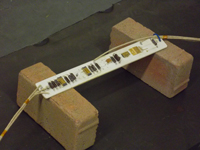 The aerospace industry is leading the development of new, very high-temperature (VHT) electronic components, which will greatly benefit the growing geothermal energy industry. Already new electronic tools for logging and monitoring hot geothermal wells are being marketed. These tools are based on VHT electronics created for future aircraft engine controls’ systems.
Aircraft engine controls require high-reliability and high-operating temperatures. Using aircraft engine electronic components, new geothermal tools can operate without the heat-shield (or Dewar) needed by conventional geothermal logging tools. The heat-shield allows normal electronics to operate within the geothermal well for four to 10 hours. Eliminating the heat-shield saves on tool costs while, at the same time, allowing new tools to operate indefinitely inside the well. The use of new VHT electronics can greatly improve the reliability of geothermal well logging, while enabling future geothermal well monitoring never before considered possible.
Understanding VHT
New VHT electronics are designed to operate at 225° C (437° F) within their specification for five years, as required by commercial aircraft engine control systems. As such, manufacturers “over” design their electronic components. Most of these electronic components operate reliably at 250° C (482° F) for years, and at 300° C (572° F) for over 300 hours.
VHT electronic devices are built using Silicon-on-Insulator (SOI) technology. SOI builds silicon circuits on top of an insulating layer of non-conductive silicon. In this way, each transistor has improved isolation from the bulk silicon used in conventional electronics. In bulk silicon, temperature dramatically increases the level of thermally generated free-electrons, which can swamp out circuit transistors. SOI reduces the creation of thermal electrons by nearly 100 times.
VHT & geothermal use
Despite the success of very high-temperature (VHT) electronic components, there have been issues preventing the use of VHT electronics in geothermal logging tools. On the aircraft engine, for example, VHT electronics are built on square ceramic circuits that are approximately 7.5 cm x 7.5 cm (3 inches x 3 inches). However, geothermal logging tools require circuits less than 2.5 cm (1 inch) wide, and a board 20 cm (10 inches) or longer.
Fortunately, a solution now exists with the development of ceramic circuits that are available in any size or shape. Now, VHT electronics can be designed for many geothermal applications. Even without the use of ceramic circuit boards, conventional polyamide circuit boards can be used up to 235° C (455° F). This lower temperature will cover most binary geothermal power plants. Plus, this technology is doing more than eliminating the heat-shield—it’s enabling electronic control systems to stay in the geothermal well.
The future of geothermal energy
The future of geothermal energy is based on the efficient collection of heat from the earth. The modern oil industry has evolved efficient well-construction practices, which are marvels at extracting oil and natural gas from the deep earth. Such oil industry well designs employ multi-lateral well completions that look like tree roots from a single surface well—in comparison, geothermal wells are still simple straws. A multi-lateral oil well employs electronic control systems and sensors to open or close control valves deep within the well. These control systems ensure the efficient drainage of the fossil energy reservoir and maximize the productive life of the well.
Future geothermal well monitoring systems, with VHT electronics for monitoring pressure, temperature, and flow, could allow the reservoir engineer to understand the energy contribution of each production zone of a multiple-production zone geothermal well. Temperature and flow contribution of each zone provides the measure of energy from that zone, while temperature and pressure allows the reservoir engineer to measure the effects of changing production rates on the reservoir over time.
Technically, at some future date, producing geothermal energy anywhere in the world could be done using man-made geothermal reservoirs. Such reservoirs are more like giant heat exchangers located in hot rock formations found at significant depths. These geothermal wells will be about six to 10 kilometers in depth, and are extremely expensive to drill. Once a well has reached geothermal temperatures and found a competent rock formation, the reservoir engineer produces fractures in the rock, extracting heat using flowing water. The only means to create economic value from such deep resources is by having multiple production zones for each well drilled.
Ideally, each production zone requires a control system to assure energy harvesting is managed to maintain well temperatures and surface power generation. New VHT electronics are enabling future geothermal power plants more efficient geothermal power production. As efficiency increases, lower temperatures with greater production from each well drilled will increase the world’s use of clean, 24-7 geothermal energy.
Randy A Normann is the general co-chair for the High-Temperature Electronics Conference (HiTEC), and also the CTO for Perma Works LLC.
Perma Works LLC
www.permaworks.com
Author: Randy A Normann
Volume: January/February 2012